

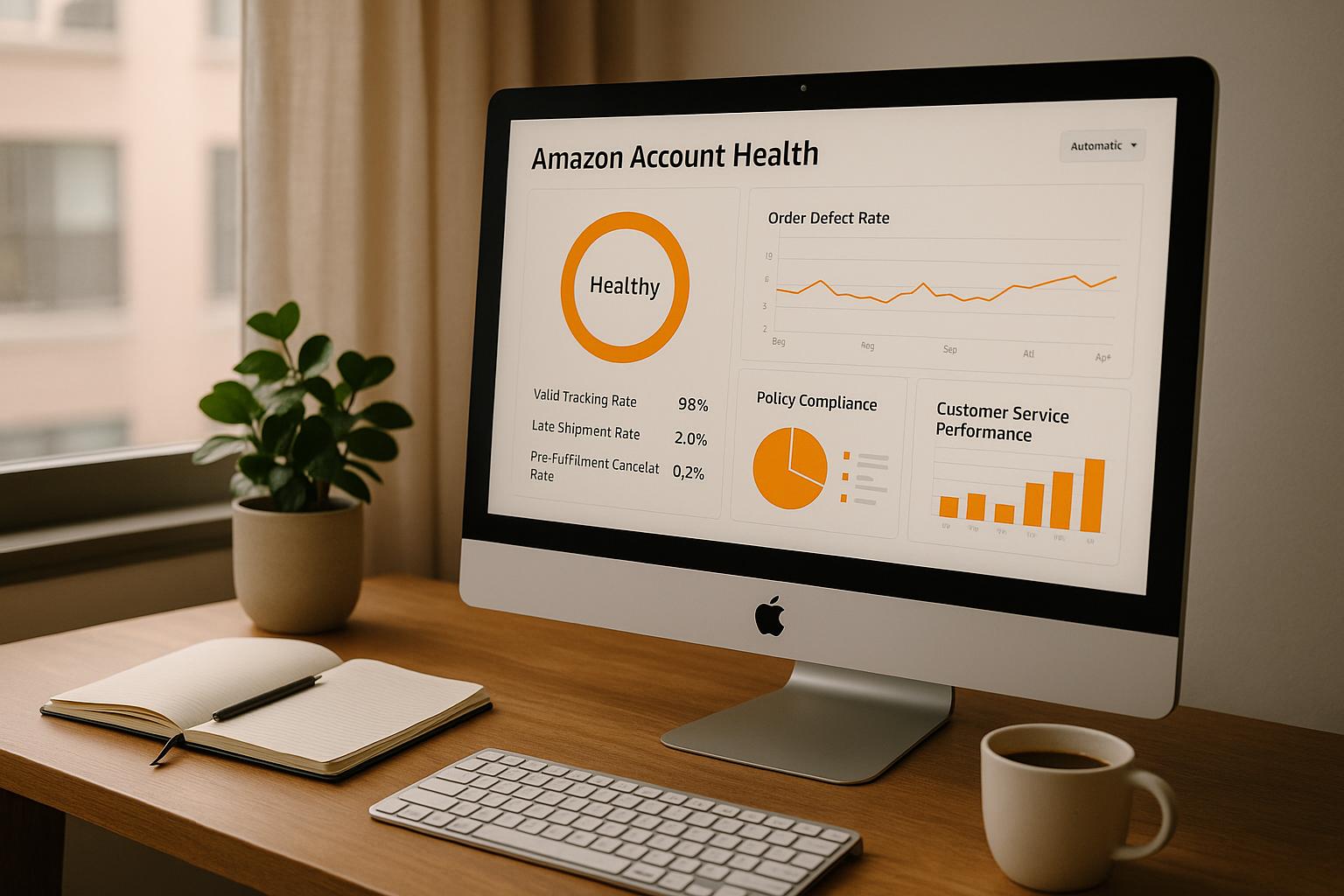
Want to keep your Amazon seller account in good standing? Here's what you need to know about Amazon Account Health Metrics:
- Account Health Rating (AHR): Scores range from 0 to 1,000.
- 200–1,000 (Green): Healthy, no risk of deactivation.
- 100–199 (Yellow): At risk of deactivation.
- 0–99 (Red): Unhealthy, eligible for deactivation.
- Key Metrics to Monitor:
- Order Defect Rate (ODR): Must stay below 1%.
- Cancellation Rate: Keep it under 2.5%.
- Late Shipment Rate: Should remain below 4%.
- Valid Tracking Rate (VTR): Needs to be above 95%.
- Invoice Defect Rate (B2B): Must stay below 5%.
- Policy Compliance: Violations like selling restricted products or intellectual property issues can hurt your score. Repeat violations lead to harsher penalties, including possible account deactivation.
- Why It Matters:
- Strong AHR boosts visibility, Buy Box eligibility, and sales opportunities.
- Poor AHR can lead to account suspension, loss of Prime status, and delayed access to funds.
Pro Tip: Regularly check your Account Health Dashboard, resolve issues quickly, and focus on customer satisfaction to maintain a healthy account.
Keep reading for a detailed breakdown of each metric and actionable strategies to protect your Amazon business.
Amazon Account Health overview
Core Amazon Account Health Metrics
Amazon keeps a close eye on specific performance metrics that determine your account's overall standing. Knowing these metrics and their thresholds is key to maintaining good account health and avoiding suspensions. Here's a closer look at the metrics that directly impact your performance.
Order Defect Rate (ODR)
The Order Defect Rate (ODR) measures negative feedback, A-to-Z claims, and chargebacks. Amazon requires sellers to maintain an ODR below 1% at all times [7][9].
Negative feedback, unresolved A-to-Z claims, or disputed charges all contribute to a higher ODR. To keep this metric in check, prioritize product quality and customer service. Regularly monitor feedback and address negative reviews quickly. Responding to customer inquiries within 24 hours can often prevent issues from escalating into claims or chargebacks [7].
Cancellation Rate and Late Shipment Rate
Amazon tracks two critical shipping-related metrics that influence customer satisfaction: the Pre-Fulfillment Cancel Rate and the Late Shipment Rate. Your cancellation rate must stay below 2.5%, while your late shipment rate should remain under 4% [7][9].
The cancellation rate measures orders canceled before shipping - often due to inventory shortages or pricing errors. To avoid cancellations, keep your inventory accurate and updated. Customers expect their orders to be fulfilled as promised, so stockouts and mismanagement can lead to frustration [7].
Late shipments occur when orders aren't shipped within the promised handling time. Amazon expects sellers to meet their stated timelines. Set realistic handling times that reflect your actual processing capabilities, and streamline your workflow to ensure timely deliveries [7]. For self-fulfilled orders, aim for an On-Time Delivery Rate above 97% by using dependable carriers [9].
Policy Compliance and Other Factors
Policy compliance is another major factor in maintaining account health. Amazon evaluates your adherence to its selling policies and product compliance requirements. Violations can include issues like intellectual property infringement, selling restricted products, or failing to meet authenticity standards.
Amazon assigns penalty points for policy violations, and repeat offenses carry heavier consequences. For example, you can have no more than five repeat violations for infringement-related policies or two for restricted product policies within a 180-day period. Exceeding these limits can trigger a violation, leaving you just three days to resolve the issue before your account faces deactivation [8][5].
Other metrics also play a role in your account health. For instance, your Valid Tracking Rate must stay above 95% [7][9]. This measures how often you provide accurate tracking information for shipments. Using carriers with reliable tracking and uploading details promptly can help you meet this requirement.
For sellers handling B2B transactions, Amazon monitors the Invoice Defect Rate, which must remain below 5% [9]. This metric evaluates the accuracy and completeness of invoices provided to business customers.
"Amazon cares a lot about giving customers a great experience, and they expect sellers to do the same." – SPCTEK INSIDER [6]
Amazon combines all these metrics to calculate your overall Account Health Rating. Each violation lowers your score, and reaching maximum limits puts your account at risk of deactivation [8][5]. Regularly reviewing your Account Health Dashboard lets you spot issues early and take corrective action before they escalate.
How Amazon Calculates Account Health Rating
Amazon uses a 1–1,000 point system to evaluate your account's adherence to its selling policies and performance standards. This system, known as the Account Health Rating (AHR), offers a clear picture of how well you're meeting Amazon's requirements and your risk level for account deactivation [10]. It's a key tool in Amazon's performance monitoring framework, as highlighted by industry experts.
"The Account Health Rating score (AHR) is a holistic measure of your selling account's adherence or compliance with Amazon's policies." - Quincy_Amazon, Amazon [1]
When you start selling on Amazon, your account begins with a baseline score of 200 points. Over a rolling 180-day period, this score is adjusted based on your compliance with policies and overall performance.
"All new sellers start with a score of 200, and over time, sellers will see a score that accurately reflects their account health based on policy adherence and selling activities over the last 180 days." - Miguel from Amazon [11]
The system works by deducting points for policy violations and awarding points for corrective actions. Additionally, you can gain points for successfully fulfilling orders - specifically, 4 points for every 200 orders fulfilled within the 180-day timeframe [10].
Amazon categorizes accounts into three groups - Healthy, At Risk, or Unhealthy - based on their scores, with a color-coded system to indicate their status.
The impact of policy violations on your score depends on their severity. Point deductions range between two and eight points, depending on whether the violation is classified as Critical, High, Medium, or Low impact [10].
- Critical violations: These are the most severe and automatically drop your AHR score to zero, regardless of your previous standing. Examples include selling counterfeit products or manipulating search rankings [1][10].
- High-impact violations: While not as severe as critical violations, these still result in significant point losses. For example, intellectual property infringement claims fall into this category.
Your AHR score is also influenced by your sales volume. As Amazon evaluates data over the rolling 180-day period, older performance metrics are replaced with newer ones. This means your score can fluctuate even if your recent performance is strong, especially if sales volumes change significantly [1].
Repeated violations of the same policy lead to harsher penalties. If you reach the maximum number of repeat violations for a single policy within 180 days, your account could face immediate deactivation, no matter your overall AHR score [3].
In extreme cases, Amazon may bypass the AHR system entirely. If your account is suspected of fraudulent, illegal, or harmful activities, it can be deactivated immediately, regardless of your current score [3]. This highlights the importance of not just maintaining good metrics but also following ethical business practices.
The AHR system provides sellers with actionable feedback on their account's status. To stay in good standing, focus on addressing the most severe violations first and ensure your emergency contact details are up to date in your notification settings [10][2]. This proactive approach can help you manage your account effectively and make strategic improvements.
sbb-itb-d7b5115
Impact of Account Health on Seller Performance
Your Amazon account health rating plays a crucial role in determining your access to essential features and revenue opportunities, directly influencing your sales potential. One of the most notable examples is Buy Box eligibility, which is a game-changer for driving sales.
The Buy Box is a key driver of revenue on Amazon, with over 83% of sales flowing through it[13]. Maintaining a strong account health score ensures you remain eligible for this coveted spot. Sellers who consistently secure the Buy Box can see sales increases of up to 300%[13]. On the flip side, poor account health can strip you of this eligibility, significantly reducing your visibility to potential customers and impacting your bottom line.
Another critical benefit tied to account health is the Amazon Prime badge. This badge assures customers that your products qualify for Prime shipping, which can heavily influence purchasing decisions. A dip in your account performance could result in losing this badge, putting you at a disadvantage against competitors who retain it.
Account suspensions are another severe consequence of poor account health. These suspensions not only halt your operations but can also delay the release of funds for up to 90 days, creating cash flow issues[15]. This delay can severely impact your ability to restock inventory, fund marketing campaigns, or cover day-to-day operational expenses.
"Amazon don't want to suspend seller accounts…but it's a very real threat for sellers who don't maintain their account health." – Assureful.com [14]
Alarmingly, about 35% of Amazon sellers in the U.S. have faced account suspensions[19]. Amazon closely monitors seller feedback to ensure customers have positive experiences[16]. A decline in account health can lead to heightened scrutiny of your performance metrics, potentially compounding existing challenges.
Poor account health can also have long-term consequences. Negative reviews and reduced ratings erode customer trust, leading to lower visibility in search results and product recommendations. Customers may start favoring sellers with stronger reputations, creating a downward spiral where declining sales further limit your ability to reinvest in inventory or improve operations.
"Figuring out Amazon changes before anyone else can help you avoid so many headaches... having a step ahead of understanding Amazon's range of actions can help visualize your next moves." – Vanessa Hung, Seller Central Expert, Carbon6 [15]
Recovering from poor account health often requires a detailed Plan of Action. This process involves submitting extensive documentation, improving internal processes, and dealing with restricted access to key features. Meanwhile, fluctuating sales caused by lost Buy Box opportunities and increased customer service demands can make inventory management even more challenging. These factors highlight the importance of actively monitoring and maintaining your account health to ensure the long-term success of your Amazon business.
Strategies for Maintaining a Healthy Amazon Account
Keeping your Amazon account in good standing is all about staying ahead of potential problems. By actively monitoring your metrics, fine-tuning your operations, and managing resources wisely, you can address issues before they spiral into major violations that might risk your selling privileges.
Monitoring and Resolving Account Issues
Your Account Health Dashboard in Seller Central is like an early warning system. It tracks your performance metrics, compliance status, and any flagged issues. To stay on top of things, enable automated alerts in Seller Central (Settings > Notification Preferences) so you’re notified of performance updates immediately. Amazon also expects sellers to respond to all buyer messages within 24 hours - missing this window could lead to account flags for inadequate customer service [20].
Keep thorough records of everything: case logs, packing slips, invoices, and even reasons for returns. These records can help you quickly identify and resolve problems. For instance, a mid-sized seller once faced a spike in returns due to unclear sizing information. After they updated their listing with precise measurements and better photos, their Order Defect Rate dropped from 3% to 0.6% in just a month, helping them reclaim their Buy Box share [20]. Having a clear escalation process in place for critical issues is also a must.
Once you’ve got monitoring down, focus on refining your processes to meet Amazon’s evolving standards.
Ensuring Compliance and Operational Excellence
Staying compliant with Amazon’s policies is critical for keeping your account in good standing. In fact, a 2024 report found that 35% of seller suspensions were due to policy violations [20]. To stay ahead, create a Policy Calendar to track important updates and deadlines. Also, maintain a log of policy changes and how your business adapts to them. Conduct monthly audits of your listings to ensure product titles, images, and categories meet Amazon’s current standards. Pay special attention to product authenticity, intellectual property rules, and communication guidelines.
Operational efficiency goes hand in hand with compliance. Meeting Amazon’s performance benchmarks can protect your account from warnings or suspensions. Here’s a quick reference:
To maintain a high Valid Tracking Rate, update tracking details promptly. Use the Voice of the Customer dashboard weekly to identify and address flagged issues. Consider investing in inventory management software to keep stock levels accurate and avoid stockouts, late shipments, or cancellations - problems that can quickly hurt your performance metrics [21].
Leveraging Financial Solutions for Growth
Sometimes, keeping your account healthy requires spending money - whether it’s on inventory, operational upgrades, or customer service improvements. But cash flow challenges can make it tough to balance these investments with day-to-day expenses. That’s where financial solutions come in.
Revenue-based financing options, like those from Onramp Funds, provide equity-free capital that adjusts with your sales performance. This type of flexible funding allows you to make necessary improvements without straining your cash flow during slower periods. In some cases, you can access funds within 24 hours, which can be a lifesaver when you need to act quickly - like sourcing higher-quality inventory to address negative reviews.
Strategic funding can support a variety of initiatives. For example, you could invest in professional product photography to reduce return rates, upgrade inventory management software for better fulfillment accuracy, or hire additional customer service staff to ensure fast response times. These investments not only help maintain your account health but also preserve key advantages like Buy Box eligibility and Prime status - both of which are essential for driving sales and sustaining long-term growth. By treating financial resources as tools to strengthen your account health, you can secure your Amazon business's future.
Conclusion
Your Amazon account health is the backbone of your selling business. With 35% of Amazon sellers in the U.S. having faced account suspension [19], maintaining strong performance metrics isn’t just important - it’s essential.
As highlighted earlier, keeping your Order Defect Rate below 1%, Late Shipment Rate under 4%, and cancellation rate below 2.5% not only helps build trust with customers but also unlocks operational perks like improved search rankings, Buy Box eligibility, and increased sales potential [17][18].
"Amazon Seller Central Account Health and Performance Metrics are the compass guiding sellers toward success on the platform."
- Steven Pope, Founder, My Amazon Guy [17]
Understanding these metrics sheds light on their immediate impact. Amazon’s Account Health Rating updates continuously over a rolling 180-day period, meaning every order and customer interaction counts [12]. This system offers both a challenge and an opportunity: while it requires consistent effort to maintain good standing, focused actions can lead to quick improvements.
Staying proactive is key. Regularly checking your Account Health Dashboard, resolving customer concerns promptly, and making operational adjustments can keep your account in good shape. For urgent situations, flexible financing options can provide a safety net without disrupting your business operations.
Amazon’s dedication to a customer-first approach means these standards will continue to evolve. As Chris Turton, Managing Director of Ecommerce Intelligence, points out:
"Amazon has historically put customers above everything else, as every clever business should, even if this means making sellers feel 'unloved' sometimes. However, we should bear in mind that the changes to AHR are ultimately for the sellers' own good." [4]
FAQs
What steps can I take to improve my Amazon Account Health Rating if it's in the yellow or red zone?
If your Amazon Account Health Rating falls into the yellow ("at risk") or red ("unhealthy") zone, it’s time to take immediate action. Start by reviewing the policy violations or performance issues outlined on your Account Health page. Key areas to focus on include order defect rates, late shipments, and policy compliance.
Here are some steps to improve your rating:
- Resolve issues promptly: Tackle any flagged violations or concerns as soon as they arise to prevent further impact.
- Focus on performance metrics: Ship orders on time, provide accurate product listings, and prioritize top-notch customer service.
- Stay proactive: Regularly check your Account Health page to catch and address potential issues early.
By consistently addressing these areas, you can work toward restoring your account to good standing, ensuring smoother operations and a better experience for your customers.
How can I comply with Amazon's selling policies and avoid account deactivation?
To keep your Amazon seller account in good standing and avoid the risk of deactivation, it’s essential to regularly check Amazon’s guidelines for product compliance, seller performance, and account health. Make it a habit to review your Account Health Metrics, resolve any flagged issues quickly, and ensure all your documentation is accurate and up-to-date.
Prioritize excellent customer service by responding to questions promptly, fulfilling orders on time, and steering clear of any policy violations. Keep a close eye on your account to catch potential problems early and address them before they grow into bigger issues. Ignoring violations or letting your account sit inactive could result in suspension or even deactivation.
Staying proactive and handling concerns early helps safeguard your account, allowing you to focus on building and expanding your Amazon business.
How does a strong Account Health Rating affect my sales and visibility on Amazon?
Maintaining a strong Account Health Rating (AHR) on Amazon is essential for growing your sales and improving your product's visibility. A high AHR shows Amazon that you're a dependable seller, increasing your chances of securing the Buy Box, which is a major factor in driving sales. Plus, it can boost your product's position in search results, making it easier for shoppers to discover your listings.
However, a low AHR can have serious consequences. It can lower your visibility, hurt your sales, and in severe cases, even lead to account suspension. To safeguard your business, it's important to keep a close eye on your metrics and quickly resolve any potential violations.
Related Blog Posts
Onramp Funds
Funding built around your sales
Connect your store and see what you qualify for. Repay as a percentage of sales, with no personal credit check.
Funding in as little as 24 hours.
