

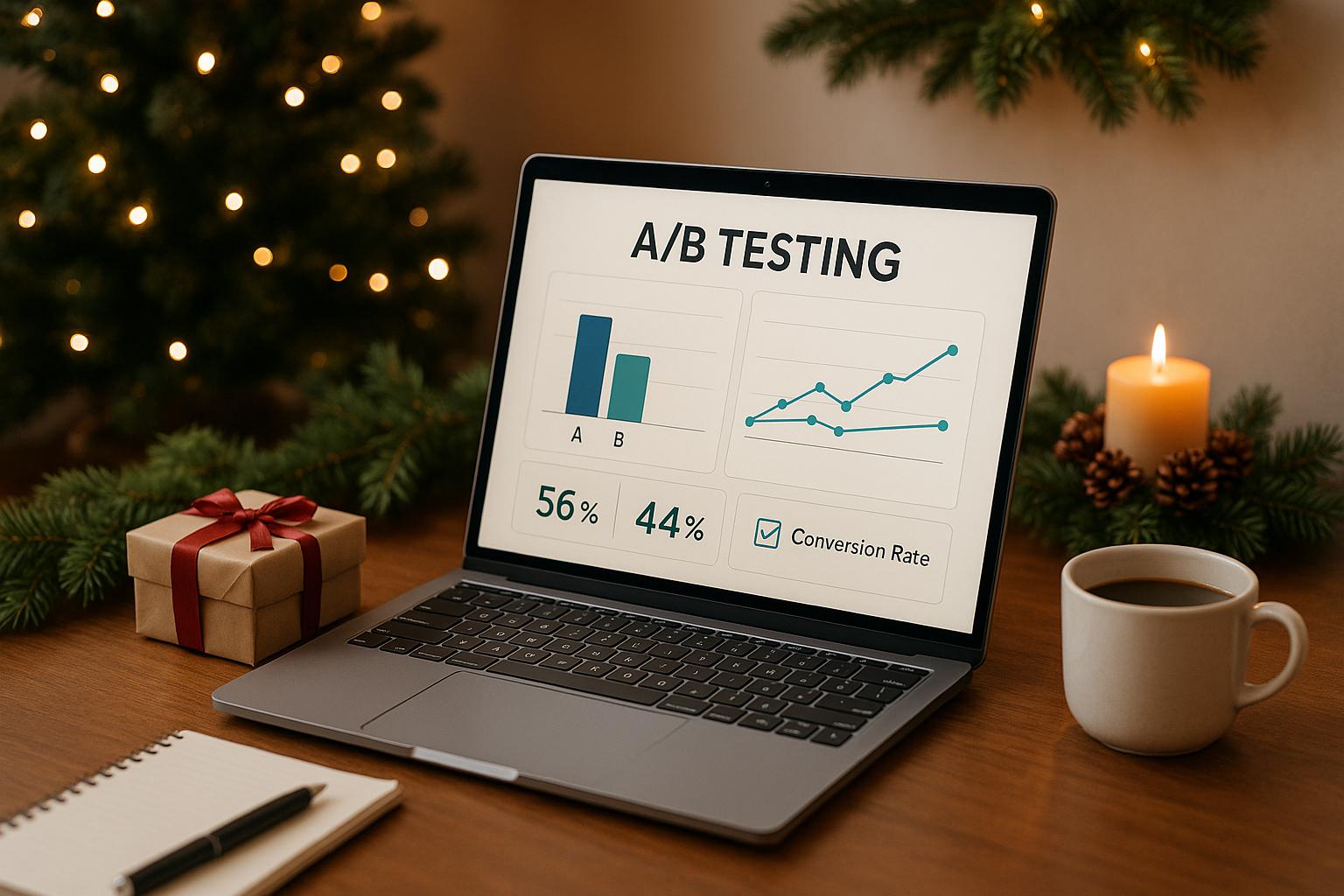
Seasonal A/B testing is a powerful way to improve your eCommerce performance during high-traffic periods like Black Friday, Cyber Monday, and Christmas. These short windows of increased demand allow businesses to test and refine strategies quickly, leveraging the surge in traffic to get faster results. Here's what you need to know:
- Why Seasonal A/B Testing Matters
- Traffic multiplies by 2–5x during holidays, allowing tests to reach statistical significance in hours or days.
- Optimized campaigns can boost conversion rates by 10–30% or more.
- Testing elements like banners, checkout processes, and urgency-driven tools (e.g., countdown timers) can drive better results.
- Shopify vs. Amazon for Testing
- Shopify: Offers full control over site elements, allowing you to test banners, pricing, and checkout flows. Third-party apps enhance testing capabilities, but technical expertise may be needed.
- Amazon: Built-in "Manage Your Experiments" tool focuses on product listing elements like titles, images, and A+ Content. Simpler to use but limited in scope.
- Challenges to Consider
- Holiday traffic skews customer behavior, meaning results may not apply year-round.
- Resource strain during peak periods can lead to rushed decisions or paused tests.
- Planning 2–3 months ahead ensures smoother execution.
- Key Testing Areas
- Shopify: Test homepage banners, discount structures, and checkout flows. Use urgency tools like countdowns and low-stock alerts.
- Amazon: Focus on product images, titles, and holiday-themed content. Test urgency messaging like "Only X left in stock!" to drive faster purchases.
- Funding for Seasonal Testing
- Revenue-based financing (e.g., Onramp Funds) can help manage inventory and marketing costs during high-revenue periods.
Quick Comparison
Conclusion: Use Shopify for customizing every detail of your site or Amazon for straightforward listing optimizations. Both platforms can drive results when used strategically during peak shopping seasons.
1. Shopify
Platform Capabilities
Shopify's testing tools are a game-changer for merchants navigating the dramatic shifts in consumer behavior during the holidays. With built-in A/B testing features and third-party integrations, Shopify allows businesses to experiment with key elements like banners, product details, pricing, and checkout processes. These tools work seamlessly with analytics to monitor crucial metrics such as conversion rates, average order value (AOV), and bounce rates - data that becomes especially vital during high-stakes seasonal campaigns[1][4].
The holiday season often brings a surge in traffic, sometimes doubling or tripling normal levels. This increased volume enables tests to reach statistical significance much faster, allowing merchants to identify and implement winning variations in real time during peak shopping periods.
For those looking to go beyond Shopify's native capabilities, third-party apps like Intelligems, Nosto, and Google Optimize offer advanced features such as audience segmentation and automated test cycles[4][5]. These tools are particularly helpful during busy holiday periods when merchants need efficient testing solutions that minimize manual effort.
Next, let’s dive into the unique challenges Shopify merchants face during these seasonal surges.
Seasonal Challenges
Running A/B tests during peak holiday seasons comes with its own set of challenges. One major hurdle is balancing the increased order volume and customer inquiries with the need to analyze data and make adjustments[4]. Many merchants pause tests during events like Black Friday to prevent disruptions, but this can mean missing out on valuable opportunities to optimize campaigns in real time[4].
Another issue is that holiday traffic often skews customer behavior. This means test results might not accurately reflect patterns during non-seasonal times[1][4][5]. On top of that, the strain on resources is significant - support teams deal with higher ticket volumes, and marketing teams work overtime to roll out campaign updates. These pressures can lead to rushed decisions or premature conclusions before tests achieve statistical significance[4].
Testing Methods
To make the most of seasonal A/B testing on Shopify, it's critical to focus on elements that directly impact conversions. Key areas to test include promotional banners, holiday-themed visuals, call-to-action buttons, product page content, and checkout processes[1][4][5]. For example, experimenting with discount structures - like comparing "10% off" to "$10 off" - can help identify the most appealing offer[1][4].
Urgency messaging, such as countdown timers and low-stock alerts, tends to perform well during the holidays when shoppers are on the lookout for limited-time deals[1][3][4]. Audience segmentation is another powerful tool. Merchants can test different strategies for first-time visitors versus returning customers, and even tailor approaches based on shopping intent. Early holiday shoppers, for instance, may respond differently than last-minute buyers[3][5].
To prepare effectively, merchants should plan their tests 2–3 months ahead of major holidays. This ensures smoother execution and minimizes disruptions[3]. Quick iteration cycles during the season allow for rapid analysis and timely adjustments, helping merchants stay agile during the holiday rush[1].
Support Options
Shopify offers a range of support options to assist merchants with seasonal A/B testing. The platform's help center and community forums provide essential guidance, while third-party testing apps often come with dedicated support teams for more specialized assistance[4][5]. Additional insights can be gathered through user testing, internal surveys, and external feedback tools to pinpoint friction points and improve the customer experience[3]. Tools like heatmaps and visitor recordings add another layer of understanding, showing why certain test variations perform better[6].
Scaling successful tests quickly often requires financial flexibility. Revenue-based financing from Onramp Funds offers merchants the ability to align funding with sales performance, ensuring they can capitalize on winning strategies.
Finally, documenting test outcomes and sharing knowledge across teams lays the groundwork for future campaigns. It’s also important to validate holiday test winners after the season ends to ensure they perform well under normal traffic conditions and aren’t just seasonal anomalies[4].
2. Amazon
Platform Capabilities
Amazon's "Manage Your Experiments" tool gives Brand-registered sellers the ability to run A/B tests directly within Seller Central. This feature allows sellers to experiment with product titles, images, A+ Content, and bullet points - all key factors that influence buyer decisions, especially during busy shopping seasons like the holidays[2]. Unlike other platforms that rely on third-party tools, Amazon's built-in system integrates smoothly with its marketplace, making the process more straightforward.
One of the tool's standout advantages is its effectiveness during peak shopping periods. With traffic surging during events like Black Friday, sellers can reach statistical significance for their tests much faster than during slower times[1][4]. This accelerated feedback means sellers can identify and implement winning variations in days rather than weeks.
That said, there are limitations. Testing is confined to elements within product listings, and sellers must operate within Amazon's ecosystem rules. Unlike Shopify sellers who can test broader site features like checkout flows, Amazon sellers focus solely on optimizing their listings. While this narrow focus can streamline efforts, it also means sellers need to prioritize the elements that most directly impact conversions.
Seasonal Challenges
Amazon's high-traffic environment during the holidays presents a unique mix of opportunities and hurdles. For example, some product categories see a 3× increase in conversion rates during Q4, but this surge can distort test results, making it harder to predict how a winning variation will perform once traffic levels return to normal[3].
Competition also ramps up during these peak times. Amazon's algorithm heavily favors listings with strong sales velocity, which means a product image or title that works well during the holiday rush might not maintain its effectiveness later. Additionally, the pressure to act quickly can lead to premature conclusions, especially if tests don't have enough time to reach statistical significance.
Testing Methods
To make the most of seasonal A/B testing, focus on high-impact elements like product images, titles, and A+ Content. For holiday campaigns, testing festive, holiday-themed images against standard product photos can provide valuable insights, though the results may only be relevant for the season[1][3][5].
Urgency messaging is another effective tactic during peak periods. For instance, comparing phrases like "Only 3 left in stock - order soon!" with standard availability messages can encourage faster purchases. Similarly, testing different ways of presenting discounts or gift-focused messaging can better align with holiday shopping behavior.
Since Amazon doesn’t allow simultaneous testing of multiple variables, it's crucial to test one element at a time. This ensures that changes in performance can be clearly linked to specific modifications, avoiding any confusion.
Planning ahead is essential. Start designing and scheduling tests well before the holiday season to allow time for adjustments and improvements[3]. Once the winning variations are identified, implement them quickly to maximize their impact during high-traffic periods.
Support Options
Amazon offers various resources to help sellers navigate the "Manage Your Experiments" tool. These include tutorials, detailed documentation, and community forums where sellers can exchange tips and troubleshoot challenges. Brand-registered sellers also gain access to in-depth analytics, which help interpret test results in the context of fluctuating seasonal traffic patterns[2]. For even deeper insights, third-party analytics tools can complement Amazon’s native features.
To scale successful tests during peak seasons, sellers can consider financing options like revenue-based funding from Onramp Funds. This type of funding ties repayments to sales performance, making it a flexible solution for managing cash flow during periods of seasonal fluctuation.
Keeping thorough documentation of each test is another critical step for long-term success. Recording details like hypotheses, variables, timelines, and outcomes helps sellers avoid repeating mistakes and builds a valuable knowledge base for future campaigns[5][6]. Comparing results from holiday and non-holiday periods ensures that optimizations remain effective year-round.
6 A/B Testing Case Studies That Worked Insanely Well
sbb-itb-d7b5115
Advantages and Disadvantages
Shopify and Amazon each bring their own approach to seasonal A/B testing, and the right choice depends on your goals and technical know-how. Understanding the strengths and limitations of each platform can help merchants make smarter decisions about where to direct their testing efforts during peak shopping seasons.
Shopify stands out for its flexibility, letting you test virtually any site element - whether it’s banners, product pages, or even checkout flows. This adaptability is especially helpful during high-traffic times like Black Friday. For example, merchants can quickly identify which landing page design works best and fine-tune it in time for Cyber Monday. Shopify also offers detailed analytics tools, allowing segmentation by traffic source, customer type, and behavior patterns, giving merchants deeper insights into their audience.
That said, this flexibility comes with some trade-offs. Making changes during critical sales periods can increase the risk of site disruptions. Plus, Shopify often requires technical expertise or third-party tools to execute tests effectively. Another challenge is that the surge in holiday traffic can skew results, making it tricky to predict whether successful variations will hold up during normal shopping periods.
Amazon, on the other hand, benefits from its built-in infrastructure and massive audience. Tools like "Manage Your Experiments" handle the technical side of testing, reducing the risk of disruptions during key sales events. Additionally, Amazon’s reputation for reliability creates a stable environment for testing. However, Amazon’s testing capabilities are more limited - you can experiment with product images, titles, and A+ Content, but you’re restricted from making broader changes to site features or the checkout process.
Here’s a quick comparison of the two platforms:
When considering long-term performance, the choice becomes even clearer. For merchants with limited resources, Amazon’s straightforward process might be the better option during busy seasons. But for businesses looking to optimize every detail, Shopify’s flexibility offers more opportunities - if you’re willing to manage the added complexity. To ensure lasting success, it’s a good idea to validate any seasonal test results with follow-up testing after the holidays.
Finally, aligning your testing strategy with your resources and growth plans is critical. Flexible financing options like Onramp Funds can help you invest in seasonal initiatives, with repayments tied directly to sales performance.
Conclusion
Choosing between Shopify and Amazon depends on your business goals and the resources you have available. Shopify works best for brands that want full control over their customer experience and have the technical know-how to handle more complex testing scenarios. If you're a direct-to-consumer business focused on experimenting with landing pages, checkout flows, and other customer touchpoints, Shopify's flexibility offers the tools you need to fine-tune your strategy during busy shopping seasons [4].
Amazon, on the other hand, is perfect for sellers prioritizing simplicity and access to a massive customer base without dealing with significant technical challenges. Its built-in split testing tools make it easy to optimize product listings, images, and pricing. This makes Amazon a great fit for high-volume sellers or those with limited technical resources who want to take advantage of holiday shopping surges [2].
It’s also important to validate your holiday testing strategies during slower periods to ensure they lead to long-term improvements [1].
To execute these strategies effectively, having enough funding is essential. Solutions like revenue-based financing from Onramp Funds can provide the capital needed for inventory, marketing, and testing tools during critical sales periods.
The most successful eCommerce businesses often use both platforms strategically - Shopify for building and customizing their brand, and Amazon for reaching a broader audience and driving volume sales. Start with the platform that fits your current needs and growth stage, and expand your testing efforts as your business scales. Use these insights to make the most of each platform’s advantages during peak shopping seasons.
FAQs
How can I make sure seasonal A/B testing results are relevant for year-round eCommerce strategies?
To make sure your seasonal A/B testing delivers insights that last beyond peak periods, focus on elements that shape customer behavior throughout the year. This might include testing pricing strategies, product descriptions, or ad copy. On the other hand, avoid testing factors tied exclusively to a specific season, like holiday-themed visuals or limited-time promotions.
It’s also essential to interpret your results within the context of broader customer trends. For instance, if a campaign performs exceptionally well during a seasonal surge, ask yourself if the tested elements cater to universal customer needs or preferences. This approach allows you to uncover insights that can guide your strategies outside of seasonal peaks, helping maintain steady growth all year long.
What are the best practices for A/B testing on Shopify during the holiday season?
To make the most of your A/B testing on Shopify during the holiday rush, start by pinpointing the areas that matter most - like product pages, checkout flows, or promotional banners. Focus on elements that can directly influence conversions, such as pricing strategies, shipping deals, or festive visuals that resonate with holiday shoppers.
It’s smart to kick off your tests early in the season. This gives you enough time to gather insights and tweak your approach before Black Friday, Cyber Monday, or other major shopping days. Track key metrics like conversion rates, average order value (AOV), and click-through rates (CTR) to measure what’s working. Stick to testing one variable at a time to keep your results accurate, and make sure your sample size is big enough to draw meaningful conclusions.
If cash flow is a concern as you ramp up for the season, tools like Onramp Funds can provide quick, equity-free funding tailored for eCommerce businesses. This kind of financial support can help you stock up on inventory or boost your marketing efforts without straining your budget. By combining well-executed A/B tests with smart financial strategies, you can set yourself up for a successful holiday season.
How can revenue-based financing help boost my eCommerce seasonal A/B testing efforts?
Revenue-based financing through Onramp Funds offers eCommerce businesses the flexibility to make the most of seasonal A/B testing. By providing fast access to the funds you need, it enables you to invest in crucial areas like inventory, marketing efforts, or platform upgrades, ensuring your testing strategies are well-executed and drive meaningful results.
What sets this funding model apart is its repayment structure, which adjusts based on your sales performance. This means it naturally aligns with the ups and downs of your seasonal revenue, helping you maintain steady cash flow while growing your business efficiently.
Related Blog Posts
Onramp Funds
Funding built around your sales
Connect your store and see what you qualify for. Repay as a percentage of sales, with no personal credit check.
Funding in as little as 24 hours.
