


Revenue-based funding (RBF) offers eCommerce businesses a flexible way to access capital. Instead of fixed monthly payments, repayments are tied to a percentage of your sales, typically 5-20%, until you repay 1.5x to 2x the amount borrowed. This approach adjusts to your revenue, easing cash flow during slow periods and scaling up when sales increase.
Key benefits include:
- No fixed payments: Repayments align with revenue fluctuations.
- Quick approval: Decisions are based on sales data, not credit scores, with funds available in as little as 24 hours.
- No equity loss: You retain 100% ownership without giving up control.
- No collateral or personal guarantees: Your personal assets are not at risk.
This funding is ideal for businesses with at least $3,000 in monthly sales and 6 months of revenue history. It’s especially useful for short-term needs like restocking inventory or seasonal campaigns, but not for long-term projects. If your revenue fluctuates and you need fast, flexible financing, RBF could be a practical solution.
What is Revenue Based Financing? (RBF)
What Is Revenue-Based Funding?

Revenue-based funding is a flexible financing model where you receive upfront capital and repay it as a percentage of your revenue until you reach a predetermined cap - usually 1.5x to 2x the original amount borrowed. Instead of fixed monthly payments, your repayments are tied to your actual earnings, typically between 5% and 20% of your monthly revenue. This setup ensures that payments align with your business’s performance, making it especially appealing for businesses with fluctuating income.
One of the standout benefits? You keep full ownership of your business. There’s no equity dilution, and no investors stepping in to influence your decisions.
Unlike traditional loans, revenue-based funding usually doesn’t require personal guarantees or collateral. Approval is based on real-time sales data from platforms like Shopify or Amazon rather than credit scores. This streamlined, data-driven process means you could get approved in as little as two hours and have funds in your account within 24 hours.
Key Features of Revenue-Based Funding
Revenue-based funding offers several advantages that cater to businesses with variable income. The repayment model is dynamic, automatically adjusting based on your sales. If your revenue dips during slower months, your repayment amount decreases proportionally, safeguarding your cash flow. There are no penalties or risks of default tied to these fluctuations.
Another benefit is the upfront clarity on repayment terms. You’ll know exactly how much you owe thanks to the predetermined repayment cap, with no hidden fees or compounding interest. Plus, the shorter repayment timelines - often aligned with eCommerce restocking cycles of 2-4 times per year - can make this option more cost-effective than long-term debt.
These features make revenue-based funding a practical choice for businesses that need flexibility and predictability.
How It Differs from Traditional Loans
Traditional bank loans come with fixed monthly payments that don’t change, regardless of how much revenue your business generates. This rigidity can strain your finances during slow periods, especially for businesses with seasonal income patterns.
Here’s a side-by-side comparison of revenue-based funding and traditional bank loans:
Revenue-based funding also stands apart from equity financing. Venture capital often requires giving up a share of ownership and comes with investor oversight, which can limit your autonomy. With revenue-based funding, you maintain full control over your business decisions. The only obligation is repaying the capital based on your revenue, free from external interference.
How Revenue-Based Funding Works for eCommerce Businesses
Application and Funding Process
Getting started with revenue-based funding is straightforward. Simply connect your eCommerce platform - whether it's Shopify, TikTok Shop, or Amazon - through a secure API. This allows the provider to analyze your sales data in real time, eliminating the need for piles of paperwork or lengthy manual processes.
Once your sales data is linked, you can receive a funding offer in minutes - sometimes as quickly as 2 hours. This offer is based entirely on your revenue performance rather than your credit score or personal assets. If you accept the terms, the funds are typically deposited into your bank account within 24 hours. Compare that to traditional bank loans, which can take weeks (or even months) to process. Once you receive the funding, repayments adjust automatically based on your sales activity.
Repayment Tied to Sales
Repayments are designed to be flexible and align with your business's performance. A fixed percentage of your daily or monthly sales - usually between 5% and 20% - is automatically deducted and sent to the funding provider. For example, if your monthly revenue is $50,000 and your repayment rate is 10%, you'll pay $5,000. If your revenue drops to $25,000, your payment adjusts to $2,500.
This system means there are no penalties for lower payments during slow periods, and you won’t face default risks due to seasonal fluctuations. You'll continue to pay the agreed percentage until you reach the repayment cap, which is typically 1.5x to 2x the original funding amount.
Funding Amounts and Eligibility
The amount you can receive depends on your annual revenue and how consistent your sales are. Funding typically ranges from 10% to 60% of your annual revenue. For example, if your store generates $200,000 annually, you could qualify for anywhere between $20,000 and $120,000, depending on your sales patterns.
To be eligible, most providers require a minimum of $3,000 in monthly revenue and at least 6 months of sales history. Unlike traditional loans, there’s no need for collateral, personal guarantees, or a strong credit score. Approval is based entirely on your business’s revenue data, making this option accessible for eCommerce sellers looking to grow - even if they don’t meet the strict requirements of traditional lenders.
sbb-itb-d7b5115
Benefits of Revenue-Based Funding for eCommerce
Revenue-based funding offers a tailored solution for eCommerce businesses, addressing their unique challenges with a structure that aligns with their revenue patterns. Here’s a closer look at why this funding model stands out.
Flexibility and Cash Flow Management
One of the standout features of revenue-based funding is its ability to adapt to fluctuating cash flow. Payments adjust based on your sales - higher during busy seasons and lower during slower periods. This flexibility means you can focus on essential operations like restocking inventory or ramping up marketing efforts without the stress of fixed repayment schedules [5].
Retain Full Ownership and Avoid Personal Risk
Unlike traditional financing options, revenue-based funding allows you to keep full ownership of your business. Once you’ve repaid the agreed amount (usually 1.5x to 2x the original funding [6][7]), your obligation ends - no lingering commitments, no sharing of profits.
Another key advantage is the lack of personal guarantees or collateral requirements. This means your personal assets remain safe, even if your business faces challenges [1][3]. These features make it an attractive option compared to conventional financing methods.
How It Compares to Traditional Bank Loans
Here’s a quick breakdown of how revenue-based funding stacks up against traditional bank loans:
This funding model is particularly appealing to eCommerce sellers who might struggle to secure traditional loans due to limited credit history, lack of collateral, or a short business track record. By focusing on your revenue and performance, revenue-based funding provides a more accessible path to growth capital [4].
Onramp Funds: Revenue-Based Financing for eCommerce
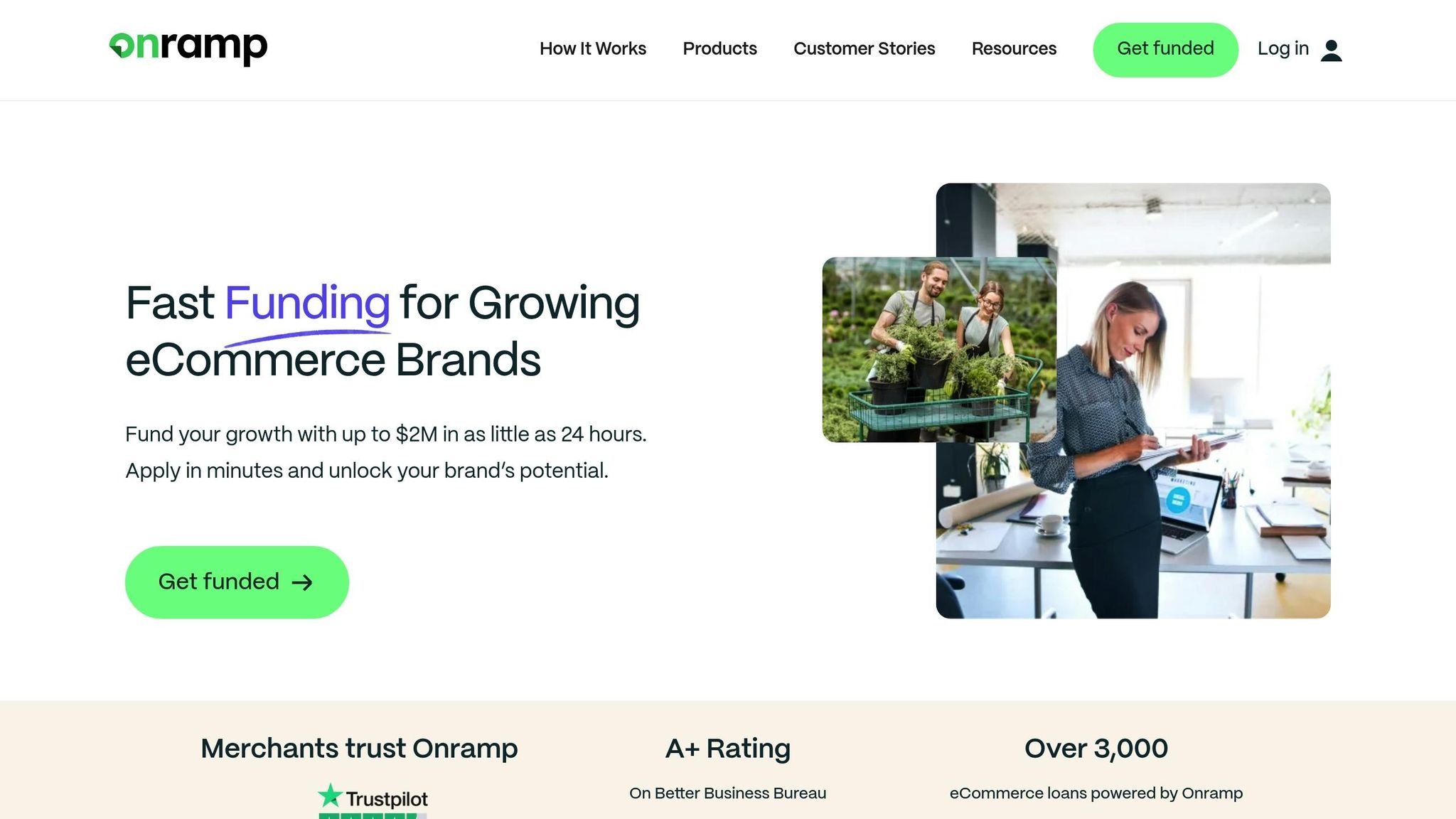
Onramp Funds takes the concept of revenue-based financing and tailors it specifically for eCommerce businesses. By connecting directly to your online store, the platform analyzes your sales data and provides funding decisions within hours - not weeks. This approach eliminates the hassle of excessive paperwork and long wait times.
Key Features of Onramp Funds
Onramp provides equity-free financing, meaning you retain full ownership of your business without needing personal guarantees or collateral. Here's how the process works:
- Get an initial estimate in just 1 minute.
- Receive a cash offer within 2 hours.
- Access full funding in 24 hours [2].
The fee structure is straightforward, ranging from 2% to 8% with no hidden charges or monthly minimums. Repayment options are flexible, allowing you to choose what works best for your business:
- Variable Payments: A percentage of daily sales (as low as 1%).
- Fixed Payments: Consistent amounts over the repayment period.
- Rolling Cash Line: A revolving capital option that scales with your sales.
Loan terms typically range from 1 to 6 months, with repayment schedules available daily, weekly, or biweekly.
Platform Integrations and Support
Onramp integrates with major eCommerce platforms, including Shopify, Amazon, TikTok Shop, Walmart Marketplace, WooCommerce, BigCommerce, Squarespace, and Shopline [8]. Connecting your store is quick - about 5 minutes - and requires only read-only access. Once connected, Onramp generates a funding offer tailored to your sales data [2].
The company’s Austin-based support team provides assistance throughout the entire process, from application to funding. This hands-on approach has earned Onramp an A+ rating from the Better Business Bureau and a "Great" rating on Trustpilot, based on 220 reviews [8].
On average, businesses see a 60% increase in revenue after securing funding, and 75% of customers return for additional financing [2].
Eligibility Requirements
To qualify for funding, your eCommerce business must meet the following criteria:
- Generate at least $3,000 in average monthly sales.
- Operate as a legal U.S. business entity, such as an LLC, Single-Member LLC, C-Corp, or S-Corp, on a supported platform [8].
There’s no minimum time in business required, and personal credit checks aren’t part of the process. Approval is based entirely on your store’s revenue performance and sales trends. This streamlined system ensures funding aligns with the unique cash flow challenges of eCommerce businesses.
Conclusion: Is Revenue-Based Funding Right for Your Business?
Revenue-based funding works well for eCommerce businesses with steady sales and fluctuating cash flow. If your business generates at least $3,000 a month, this funding model adjusts to your income - offering lower payments during slower times and higher ones during busy periods like Black Friday.
Unlike traditional bank loans that come with fixed monthly payments and can strain your cash flow, revenue-based funding offers flexibility. It lets you keep full control of your business without requiring personal guarantees or collateral. This makes it especially appealing for sellers on platforms like Shopify, Amazon, or TikTok Shop, where revenue often varies seasonally.
If you need quick access to capital - sometimes within 24 hours - this option is worth considering. Instead of relying on credit scores, lenders focus on your sales data, making it accessible even for newer businesses. However, it’s best suited for short-term needs, like restocking inventory a few times a year, rather than long-term projects such as building a warehouse. This approach ensures you can meet immediate growth goals without putting unnecessary strain on your cash flow.
Take a look at your recent sales trends and growth plans. If you’re looking to scale your marketing, expand to new sales channels, or avoid running out of stock during high-demand periods, revenue-based funding offers a flexible way to invest. The repayment structure - usually 5-10% of your gross revenue - adjusts with your business performance, ensuring payments stay manageable during slow periods and ramp up when sales are strong. It’s a practical solution for businesses seeking to grow without giving up equity or taking on rigid debt.
FAQs
What is the difference between revenue-based funding and traditional bank loans?
Revenue-based funding works on a repayment model tied directly to your business's monthly revenue. Instead of a fixed amount, you pay back a percentage of what you earn, which means payments adjust according to your cash flow. This setup can be especially helpful during slower months. On top of that, the approval process is usually quick, there's no need to put up collateral, and credit checks are minimal.
On the other hand, traditional bank loans stick to fixed monthly payments, regardless of how your business performs. They often require collateral and involve thorough credit checks and underwriting. Plus, getting approved for a bank loan tends to take longer, and the repayment terms aren’t as flexible when your revenue fluctuates.
What do I need to qualify for revenue-based funding?
To be eligible for revenue-based funding, your business needs to meet several important criteria:
- Be a U.S.-based eCommerce business with a legal structure like an LLC, C-Corp, or S-Corp, and have an EIN.
- Show at least 6–12 months of operating history. Businesses with shorter histories might still qualify if they have well-documented sales.
- Maintain a minimum average monthly revenue of $3,000 (equivalent to about $100,000 annually). Many funding programs prefer businesses with monthly sales between $10,000 and $20,000.
- Use a supported eCommerce platform such as Shopify, Amazon, or WooCommerce, with API access to sales data.
- Have essential business documentation, including formation papers, a business bank account, and recent financial or bank statements.
Meeting these requirements demonstrates that your business has the cash flow needed for flexible repayments tied to revenue, making this funding option a practical way to drive growth.
Can revenue-based funding support long-term business growth?
Revenue-based funding can be a smart way to support long-term growth, thanks to its flexible repayment structure that's tied directly to your business's revenue. This setup allows you to better manage cash flow, especially during times when sales might be unpredictable.
Because payments fluctuate in line with your earnings, this funding model gives you the flexibility to reinvest in your business, expand operations, and maintain steady growth without the pressure of fixed monthly payments.
