


Every marketing dollar should work hard for your business. To evaluate its impact, focus on two metrics: Return on Ad Spend (ROAS) and Customer Acquisition Cost (CAC). These metrics reveal whether your ad spend is driving revenue and if acquiring customers aligns with your business goals.
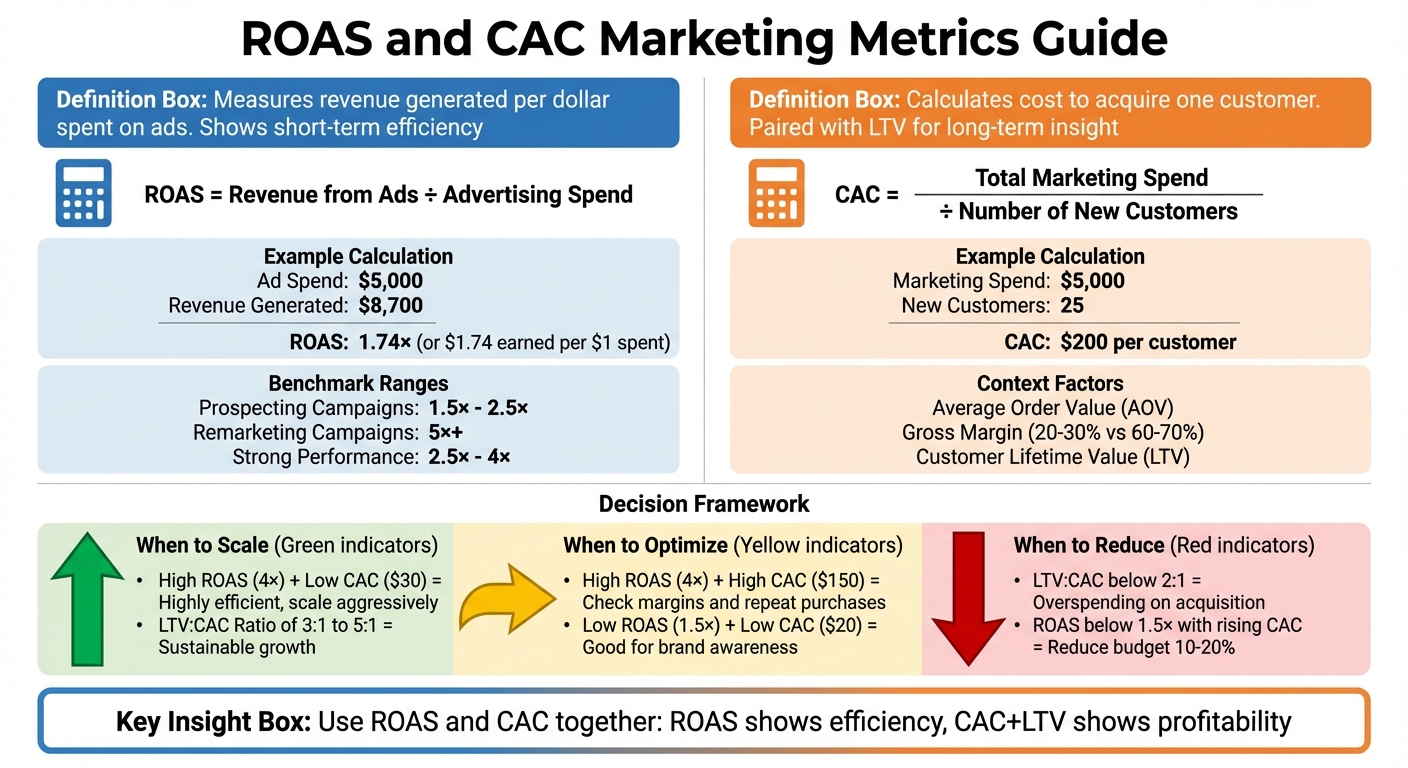
- ROAS measures how much revenue you generate for every dollar spent on ads. For example, $5,000 in ad spend generating $8,700 in revenue equals a ROAS of 1.74.
- CAC calculates the cost to acquire one customer. For instance, $5,000 spent to gain 25 customers results in a CAC of $200.
Why these matter: High ROAS paired with low CAC signals efficiency and profitability. However, focusing on one metric alone can be misleading. Combining both helps you identify scalable campaigns, allocate budgets wisely, and ensure long-term growth.
In this article, you'll learn:
- How to calculate ROAS and CAC.
- How to use these metrics to guide budget decisions.
- Why pairing ROAS and CAC with Lifetime Value (LTV) is critical.
- Tips for optimizing marketing channels and scaling budgets effectively.
Key takeaway: ROAS shows short-term efficiency, while CAC paired with LTV gives insight into long-term growth. Together, they help you make smarter budget decisions.
How Does ROAS Relate To Customer Acquisition Cost (CAC)? - Marketing and Advertising Guru
How to Calculate ROAS and CAC
Now that we’ve covered the basics of ROAS and CAC, let’s dive into how to calculate and refine these metrics. The formulas themselves are simple, but accuracy depends on clearly defining your parameters and tracking your data consistently.
ROAS Formula and Example
The formula for ROAS is: ROAS = Revenue from Ads ÷ Advertising Spend[2][5]. Essentially, you divide the total revenue generated from your advertising campaign by the amount spent on those ads. The result shows how much revenue you earn for every dollar spent.
For instance, if you spend $5,000 on ads and generate $8,700 in revenue, your ROAS would be 1.74×[2]. In other words, for every dollar you invest in advertising, you’re earning $1.74 in return. For prospecting campaigns - designed to reach new audiences - a ROAS between 1.5× and 2.5× is common and considered a good benchmark[2]. On the other hand, remarketing campaigns often deliver higher ROAS since they target audiences already familiar with your brand[2].
Once you’ve calculated ROAS, the next step is to figure out your CAC to gauge how much it costs to bring in each new customer.
CAC Formula and Example
The formula for Customer Acquisition Cost is: CAC = Total Marketing Spend ÷ Number of New Customers Acquired[2][6]. This metric reflects the total cost of acquiring a new customer, factoring in all marketing and sales expenses over a specific period[6].
Let’s use the same $5,000 spend as an example. If this investment brings in 25 new customers, your CAC would be $200 per customer[2]. Whether this is a healthy figure depends on your business’s gross margin and the likelihood of repeat purchases[2]. For instance, if your average order value is $120 but customers tend to make multiple purchases over time, a $200 CAC might still be profitable due to the long-term value of those customers[2].
Key Factors for Accurate Calculations
Focus on media costs first. Start by including only your ad platform spending - such as Google Ads, Facebook Ads, or TikTok Ads[7]. You can later decide whether to add other costs, like agency fees or creative expenses, but make sure you apply your chosen definition consistently across all campaigns. Consistency is crucial for ensuring your metrics are comparable over time[7].
Select an appropriate time frame. For campaigns with frequent transactions, tracking ROAS daily can help you quickly identify inefficiencies[8]. Many eCommerce brands, however, prefer weekly reviews to spot trends without overreacting to short-term fluctuations[8]. For longer-term initiatives, monthly reviews are usually sufficient[8]. When calculating CAC, align the time frame with your business cycle - monthly or quarterly reviews often work best[4].
Use a consistent attribution model. Whether you choose first-click, last-click, or multi-touch attribution, stick with one model to ensure your results are comparable over time[3]. If you’re juggling multiple campaigns, track each channel separately to pinpoint which ones deliver the best results[4]. These detailed calculations will lay the groundwork for smarter budget allocation, which we’ll explore in the next section.
Using ROAS and CAC for Budget Allocation
Once you’ve calculated your ROAS (Return on Ad Spend) and CAC (Customer Acquisition Cost), you can start making smarter decisions about where to allocate your budget. The key is to identify what "healthy" performance looks like for your business and use these metrics together to guide your spending. This approach enables you to adjust campaigns and reallocate budgets effectively.
Healthy ROAS and CAC Benchmarks
Healthy benchmarks for ROAS and CAC depend heavily on your business model and margins. For example:
- ROAS Benchmarks: A ROAS between 2.5× and 4× is generally strong for prospecting campaigns, while remarketing campaigns often aim for 5× or higher.
- CAC Context: A $200 CAC might be acceptable for a product with a $120 Average Order Value (AOV) if the Lifetime Value (LTV) supports it. However, a $40 AOV likely won’t justify the same CAC[2].
Your gross margin plays a huge role in determining what’s feasible. Businesses with high margins (60–70%) can afford higher CACs and lower ROAS because they have more profit cushion per sale. In contrast, businesses with slimmer margins (20–30%) often need a ROAS of 4× or more just to break even. For instance, a mid-range fashion brand might aim for a CAC of $50–$100, while premium electronics brands could justify $200–$400 CACs if their margins and LTV align[2].
Using Both Metrics Together
ROAS and CAC work best when analyzed together. For instance:
- A high ROAS (4×) combined with a low CAC ($30) signals a highly efficient channel that’s likely worth scaling[4].
- On the other hand, a 4× ROAS with a CAC of $150 requires deeper analysis. Check your margins and whether customers are making repeat purchases to gauge if the channel is sustainable.
Sometimes, even a low ROAS (1.5×) can be acceptable - such as in top-of-funnel brand awareness campaigns with a very low CAC ($20). These campaigns might not be immediately profitable but could drive valuable downstream conversions. The goal is to align CAC with LTV while ensuring ROAS is high enough to cover your costs and generate profit. Remember, ROAS reflects short-term efficiency, while CAC paired with LTV gives you a clearer picture of long-term growth potential[9].
The LTV:CAC Ratio
The LTV:CAC ratio adds another layer to your decision-making process. A healthy ratio typically falls between 3:1 and 5:1. For example, if your CAC is $100 and your LTV is $400, you have a 4:1 ratio, which indicates efficient acquisition and scalability[4][5].
- If the ratio drops below 2:1, you’re likely overspending on acquisition relative to customer value. In this case, consider reducing CAC or boosting retention efforts.
- If the ratio exceeds 5:1, it might suggest you’re underspending on customer acquisition. This could be an opportunity to expand your marketing budget without risking profitability.
sbb-itb-d7b5115
Optimizing Marketing Channels with ROAS and CAC
Measuring Metrics by Channel
To get the most out of your marketing efforts, it's essential to track ROAS (Return on Ad Spend) and CAC (Customer Acquisition Cost) for each channel individually - whether it's Facebook, Google Ads, TikTok, or email. Pull data on ad spend and attributed revenue directly from each platform's analytics or through a centralized dashboard. Then, calculate ROAS by dividing the revenue generated by your ad spend, and find CAC by dividing the total acquisition costs by the number of new customers acquired [2].
Breaking metrics down by channel helps you spot the top performers and those lagging behind. For the most accurate insights, keep new-customer campaigns separate from retention or remarketing efforts. This way, your metrics reflect the true efficiency of your acquisition strategies. With this granular view, you’ll be better equipped to shift budgets toward the channels that deliver the best results.
Reallocating Budget for Better Results
Once you’ve identified which channels are driving the best performance, it’s time to reallocate your budget. Focus on channels with high ROAS, low CAC, and a favorable LTV:CAC ratio. For example, if Google Ads delivers a 3.5× ROAS with a $120 CAC, while TikTok shows a 1.8× ROAS with a $280 CAC - and your customer lifetime value (LTV) is $600 - Google Ads would clearly be the better choice for scaling.
Budget adjustments should be gradual. Increase spending on high-performing channels by 20–30% at a time, and monitor results for at least a week before scaling further. On the flip side, don’t rush to cut underperforming channels. Instead, test optimizations like fresh creative assets, refined targeting, or enhanced landing pages. Often, a channel just needs some fine-tuning rather than complete abandonment. As you scale the budget on successful channels, keep an eye on CAC, as many platforms tend to become less efficient with higher ad spend.
Regular Monitoring and Adjustments
Effective budget allocation isn’t a one-and-done process - it requires ongoing monitoring. For high-volume campaigns, review performance weekly; for others, a monthly check-in may suffice. Stay alert for changes in efficiency. For instance, if a channel’s ROAS drops below your target (e.g., under 1.5×), consider reducing the budget by 10–20% and investigate the cause. Similarly, if CAC rises significantly without an increase in LTV, pause scaling efforts and focus on optimizing your funnel.
Scaling Marketing Budgets with Flexible Financing
Why Flexible Financing Matters for Marketing
When you're managing ad spend with metrics like ROAS (Return on Ad Spend) and CAC (Customer Acquisition Cost), having access to flexible financing can be a game-changer. For most eCommerce businesses, there's often a timing mismatch between when marketing dollars need to be spent and when revenue actually lands in the bank. Take Q4 or major shopping events like Prime Day, for example - you have to invest heavily in ads weeks before the sales roll in. At the same time, you're juggling inventory costs, 3PL fees, and platform charges. Add marketplace payout schedules and return windows into the mix, and you’ve got a recipe for cash flow gaps.
This mismatch can limit your ability to scale campaigns, no matter how strong your ROAS and CAC metrics are. In fact, surveys show that 82% of business failures are tied to cash flow issues, not profitability. Having the right capital at the right time can be the key to scaling successful campaigns. Without it, even your most optimized strategies could stall.
How Onramp Funds Supports Budget Decisions

To address these cash flow challenges, Onramp Funds provides revenue-based financing tailored for eCommerce sellers on platforms like Amazon, Shopify, Walmart Marketplace, and TikTok Shop. Here's how it works: instead of fixed monthly payments, you repay a percentage of your sales on a daily or weekly basis. This means if revenue dips during slower months, your payments automatically adjust downward. It’s a model designed to sync with your ROAS and CAC cycles, giving you the flexibility to keep scaling as performance improves. When your sales grow, repayments accelerate, freeing up capital for reinvestment into high-performing campaigns.
"Applied, got our offer, and had cash in our bank account within 24 hours. Their Austin, TX based team was very professional and helped me deploy the cash to effectively grow our business." - Nick James, CEO, Rockless Table [1]
Benefits of Using Onramp Funds for Marketing Growth
Onramp Funds offers fast access to capital - within 24 hours, so you can act quickly when campaigns hit target ROAS or during peak shopping seasons. Unlike traditional loans, their financing is equity-free, meaning you retain full ownership of your business while scaling your marketing efforts. The funds are versatile, too - you can use them for marketing, inventory, or shipping, giving you the freedom to invest where your data shows the best returns.
The results speak for themselves: customers see an average of +55% revenue growth within 180 days of using Onramp, and 56% of users borrow again, showing the model supports long-term growth rather than just a quick boost [1]. With an A+ Better Business Bureau rating and glowing reviews on Trustpilot, Onramp combines speed, flexibility, and reliability to help you scale your marketing without the cash flow headaches of traditional financing.
Conclusion
Using ROAS and CAC together gives you the clarity needed to make smarter decisions about your marketing budgets. When you track these metrics alongside customer lifetime value (LTV), it becomes easier to identify which channels are worth scaling and which ones might need adjustments. The secret is consistency - define what costs you’re including in your calculations and stick with that approach across all campaigns to ensure your comparisons stay accurate[7]. This unified perspective helps guide strategic shifts in budget allocation across channels.
The most successful eCommerce businesses don’t treat these metrics as one-and-done calculations - they see them as part of an ongoing feedback loop[8]. This data helps you reallocate budgets toward channels with strong ROAS and manageable CAC in relation to your LTV. A solid LTV:CAC ratio, ideally around 3:1, indicates sustainable growth[9]. And when your numbers show potential for scaling, it’s a clear signal to double down on what’s working.
Sometimes, cash flow timing can make it tough to act on strong ROAS and CAC results right away. That’s where revenue-based financing from Onramp Funds can help. Their approach ties repayments to your sales performance, letting you invest in high-performing campaigns without the pressure of fixed monthly payments.
FAQs
How do I use ROAS and CAC to make smarter marketing budget decisions?
To get the most out of your marketing budget, it's crucial to strike a balance between Return on Ad Spend (ROAS) and Customer Acquisition Cost (CAC). ROAS tells you how much revenue your campaigns generate for every dollar spent, while CAC reveals the cost of bringing in each new customer.
Keep a close eye on these numbers and adjust your spending to boost profitability. For instance, if your CAC is climbing too high, you might need to fine-tune your targeting or optimize your campaigns to bring costs down. On the other hand, to improve your ROAS, focus on channels that consistently deliver strong returns. Finding the sweet spot between these two metrics is essential for smarter spending and sustainable growth.
Why is it important to analyze CAC alongside Lifetime Value (LTV)?
Analyzing Customer Acquisition Cost (CAC) alongside Lifetime Value (LTV) is a smart way to gauge the profitability of your marketing efforts over time. Essentially, you're comparing what it costs to bring in a customer (CAC) against the revenue they generate throughout their relationship with your business (LTV). This comparison reveals whether your customer acquisition strategies are financially sustainable and delivering a good return on investment.
For instance, if your LTV is much higher than your CAC, that's a strong indicator that your marketing efforts are both cost-efficient and driving growth. On the other hand, if CAC outweighs LTV, it’s a signal to revisit your approach. You might be spending too much on acquiring customers who don’t bring in enough revenue to justify the cost.
This kind of analysis allows you to make smarter, data-backed decisions about how to allocate your marketing budget and fine-tune your campaigns to boost profitability.
How can revenue-based financing help grow your marketing efforts?
Revenue-based financing provides businesses with quick and flexible access to funds, allowing them to boost their marketing efforts without giving up equity or jeopardizing cash flow. Since repayments are based on a percentage of your sales, this approach offers breathing room during slower revenue periods.
With this financing option, you can ramp up marketing campaigns, experiment with fresh strategies, or explore new advertising channels - all while ensuring your financial stability stays in sync with your revenue trends.
Related Blog Posts
Onramp Funds
Funding built around your sales
Connect your store and see what you qualify for. Repay as a percentage of sales, with no personal credit check.
Funding in as little as 24 hours.
