

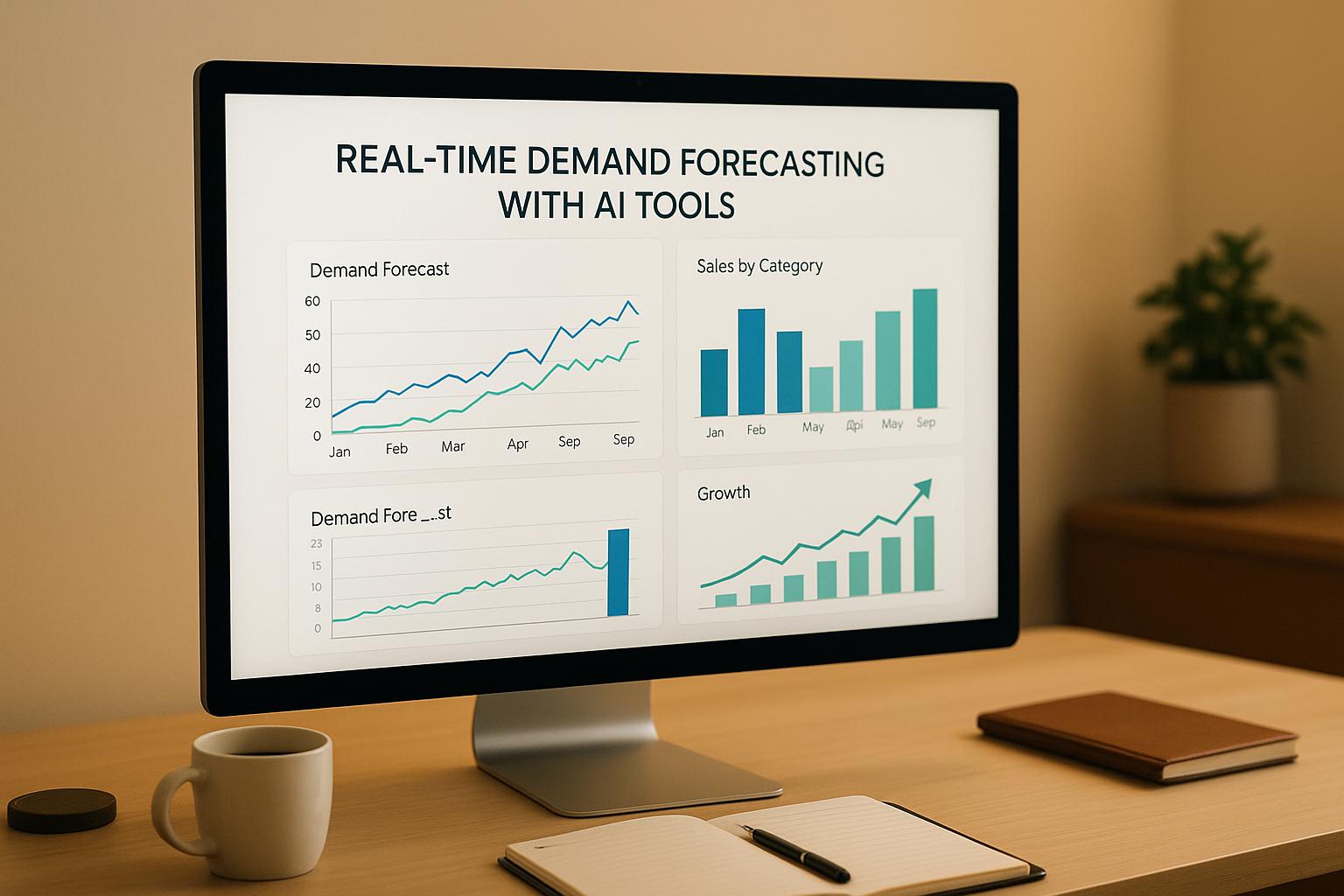
Real-time demand forecasting uses AI to analyze up-to-the-minute data, helping businesses predict customer needs instantly. Unlike older methods that rely on periodic updates, this approach integrates current trends, social signals, and external factors to improve accuracy and decision-making. For eCommerce, where demand shifts quickly, AI-powered forecasting reduces errors, improves inventory management, and boosts profitability.
Key Takeaways:
- Why It Matters: eCommerce businesses face challenges like stockouts, overstocks, and seasonal demand. AI forecasting helps reduce inventory errors by 30–50% and improves accuracy by 20–30%.
- How It Works: AI combines historical data with real-time inputs (like social trends and sales patterns) using machine learning models such as regression, time series, and neural networks.
- Business Benefits: Companies like Walmart and Zara have saved millions by using AI to cut waste, improve delivery times, and optimize stock levels.
- Tools & Tech: Cloud platforms, IoT devices, and predictive analytics enable scalable and precise forecasting.
- Implementation: Clean data, the right AI tools, and tracking KPIs like forecast accuracy and stockout rates are crucial for success.
AI-driven forecasting isn’t just about better predictions - it’s about smarter, faster decisions that directly impact revenue and customer satisfaction.
How AI Is Revolutionizing Demand Forecasting (Ecommerce & Supply Chain Guide)
Key Technologies Behind AI-Driven Demand Forecasting
Grasping the technologies that drive AI-based demand forecasting is crucial for eCommerce businesses looking to make smart tech investments. These tools work together to build systems that can predict customer demand with speed and precision.
Machine Learning Models for Forecasting
Machine learning models are at the heart of real-time demand forecasting, constantly analyzing massive datasets and adapting to market shifts [4]. These systems uncover complex patterns and refine their predictions as they process new data.
Here are some of the key machine learning approaches used for demand forecasting in eCommerce:
- Regression analysis is ideal for understanding straightforward relationships, like how changes in pricing or promotional strategies influence demand. This approach is perfect for businesses experimenting with pricing models [4].
- Time series forecasting shines when it comes to identifying seasonal trends and long-term sales patterns. Tools like LSTM (Long Short-Term Memory) networks are particularly effective at recognizing recurring demand spikes, such as those during Black Friday or back-to-school shopping seasons [4].
- Random forests and decision trees excel in environments where multiple variables interact to influence demand. These methods combine insights from multiple models to isolate the most important drivers of customer behavior [4].
- Neural networks and deep learning are powerful for detecting intricate patterns in large datasets, including unstructured data like customer reviews, social media chatter, and images. This is especially useful for businesses influenced by social trends and consumer sentiment [4].
- Support vector machines (SVM) are effective in capturing non-linear relationships, making them valuable in markets with complex interactions. Meanwhile, reinforcement learning dynamically adjusts predictions in real time, optimizing inventory levels based on current sales data [4].
The results speak for themselves: businesses using AI for demand planning have cut forecasting errors by up to 50%. In supply chains, AI-driven forecasting has slashed errors by 30% to 50% [5]. According to Gartner, 75% of organizations are expected to adopt AI-based forecasting models by 2024 [5].
While algorithms are the backbone, scalable cloud solutions play a critical role in supporting these systems.
Cloud-Based Solutions for Scalability
Cloud technology allows eCommerce businesses to scale their resources as needed, while shifting from upfront capital expenses to pay-as-you-go operational costs. By 2030, the global cloud logistics market is projected to surpass $46 billion, growing nearly 14% annually from 2025 [9].
Cloud platforms provide real-time data integration and cost-effective scaling [6][7]. This eliminates the need for overbuilt infrastructure and reduces IT staffing requirements.
Some of the biggest names in retail are already seeing the benefits:
- Amazon.com leverages SAP ERP to streamline supply chain management, financial planning, and customer service. By integrating AI, SAP ERP gives Amazon real-time insights that improve decision-making, control costs, and enhance customer satisfaction [8].
- Walmart uses Oracle ERP Cloud to automate inventory tracking and optimize procurement. These tools have simplified operations, lowered costs, and improved decision-making [8].
Cloud-based logistics systems have boosted demand forecasting accuracy by 26% and reduced operational costs by 16% [9]. Smaller eCommerce companies also benefit from these tools, gaining access to robust forecasting capabilities without needing extensive in-house infrastructure [1].
IoT devices further enhance these systems by providing real-time data streams.
Using IoT and Real-Time Data Streams
IoT devices gather continuous, real-time data, enabling precise tracking of inventory and conditions. The global IoT retail market is on track to hit $350.85 billion by 2032, growing at an annual rate of 25.4% from 2024 [11].
- RFID tags and smart sensors provide 24/7 monitoring of inventory, tracking movement and storage conditions in real time [11].
- IoT sensors also monitor environmental factors, reducing losses and ensuring product quality. For example, Kroger uses temperature sensors in its fridges and freezers to maintain optimal storage conditions. Alerts are sent to managers when issues arise, preventing spoilage and ensuring food safety [10].
By applying predictive analytics to IoT data, businesses can improve supply chain efficiency and better understand customer behavior. Historical sales data, seasonal trends, and external factors are all considered to enhance forecasting accuracy [11].
The benefits of IoT integration are undeniable. Businesses using real-time inventory tracking have reduced out-of-stock rates by up to 30%, while smart inventory solutions have led to a 15% increase in sales [11]. Predictive analytics in eCommerce is expected to grow at an annual rate of 21.4% through 2032, further highlighting its importance in inventory management [11].
IoT systems also reduce operational costs, improve customer satisfaction, and boost revenue. Automated reorder points, driven by real-time stock levels and sales trends, ensure accurate inventory management. Cloud platforms complement IoT by providing scalable, cost-efficient storage and processing for the vast amounts of data these devices generate [10].
Benefits of Real-Time AI Forecasting for eCommerce
Real-time AI forecasting is reshaping eCommerce by making operations smoother and more profitable. This technology processes massive amounts of data and adjusts to changing conditions, offering advantages that older forecasting methods just can’t match.
Better Inventory Management
AI-powered forecasting takes the guesswork out of managing inventory, helping businesses strike the right balance between overstocking and running out of products. By combining historical sales data with real-time market trends, AI systems can accurately predict demand shifts.
Take Amazon, for example. The company uses machine learning to manage inventory for over 400 million items. Thanks to its AI models, Amazon has reduced excess stock by 15% to 20%, which not only speeds up deliveries - including same-day service in many areas - but also keeps customers happy [2].
Meanwhile, Walmart uses its Eden system to analyze more than 1.6 billion data points daily. This system has delivered impressive results, such as cutting $86 million in food waste within a year and improving forecasting accuracy by 20%. These improvements lead to smarter inventory decisions and better product availability [2].
AI systems also excel in adapting to sudden changes, like unexpected demand spikes or supply chain issues. This capability ensures businesses can maintain service levels even when market conditions shift dramatically [12].
Faster Order Fulfillment and Customer Satisfaction
AI doesn’t stop at inventory - it also speeds up order fulfillment. Accurate demand forecasting allows businesses to strategically position inventory, reducing delivery times and improving the overall customer experience. When companies know what their customers want and when, they can fine-tune their supply chain for speed and reliability.
Target is a great example of this. Its Inventory Ledger system makes billions of predictions each week to ensure accurate product availability [3]. A 2020 holiday survey found that 53% of shoppers won’t return to a retailer after receiving an incorrect order, highlighting the importance of precise fulfillment [14]. AI helps by automating item verification and tracking real-time inventory and sales data, ensuring orders are correct and delivered on time [3]. Additionally, AI improves delivery speeds through better route planning, predictive maintenance, and full supply chain visibility [14].
Higher Profit Margins with Data-Driven Decisions
Better inventory management and faster fulfillment directly boost profitability. AI-driven forecasting helps businesses allocate resources wisely, cut waste, and improve overall returns. With accurate demand predictions, companies can make smarter choices about pricing, inventory, and operational investments.
Zara is a standout example. By analyzing real-time sales data, social media trends, and customer buying patterns, Zara adjusts its inventory quickly and efficiently. This approach ensures that 85% of its products sell at full price, a major factor in the company’s strong profitability [2].
Similarly, UPS uses its AI-powered ORION system to optimize delivery routes and forecast demand. By analyzing data from over 250 million address points daily, ORION has helped UPS reduce annual driving distances by 100 million miles, saving $300 to $400 million each year in fuel and labor costs [2].
According to a 2023 McKinsey survey, companies using AI for demand planning see their EBIT rise by over 5% in 25% of cases [3]. AI can also automate up to 50% of workforce management tasks, cutting costs by 10% to 15% while improving hiring decisions and operational stability [13]. Additionally, AI reduces supply chain errors by 20% to 50%, leading to a 65% improvement in operational efficiency due to fewer lost sales and better product availability [13]. Dynamic pricing strategies, powered by real-time demand signals, further enhance profitability by allowing businesses to stay competitive while maximizing revenue [3].
sbb-itb-d7b5115
Steps to Implement Real-Time AI Forecasting
Integrating AI-powered forecasting into your business involves preparing your data, selecting the right tools, and continuously refining your strategy for optimal results.
Preparing Your Data for AI Integration
Start by ensuring your data is accurate, consistent, and complete. This means addressing gaps, fixing anomalies, removing duplicates, and resolving inconsistencies before feeding it into an AI system [15]. For example, if your business sells seasonal products, make sure your historical data covers entire seasonal cycles rather than fragmented periods.
Standardization is key when working with data from multiple sources. For instance, if your Shopify sales data uses a different coding system than your warehouse management software, align these codes before analysis. Regular updates are also crucial - set up automated feeds to refresh your AI models on a weekly or bi-weekly schedule [15][16].
Once your data is clean and unified, you’re ready to choose an AI tool that matches your specific business needs.
Choosing the Right AI Tools for Your Business
Before selecting an AI tool, identify the main forecasting challenges you want to address - whether it’s avoiding stockouts, reducing excess inventory, or improving demand accuracy.
Look for tools with flexible pricing, seamless integration with platforms like Shopify, BigCommerce, or WooCommerce, and an easy-to-use interface. Opt for solutions that offer free trials or demo versions so you can test them with your actual data before committing [18][19][20]. Comprehensive customer support is especially valuable if your team lacks dedicated data scientists.
A good AI tool should provide clear visualizations and actionable insights, making it easier for your team to interpret and act on forecasts. Security is another critical factor - features like encryption, fraud detection, and access controls are essential to safeguard your customer and sales data.
To get the most out of AI, define specific use cases. For example, you might use the technology to manage limited historical data for seasonal product launches or to incorporate external trends into your forecasts [17].
Tracking KPIs and Improving Over Time
Once your AI tool is up and running, measure its effectiveness using key performance indicators (KPIs). Focus on metrics like forecast accuracy (aim for 90–95%), stockout frequency, inventory turnover, holding costs, waste reduction, and GMROI [21]. Studies show that AI forecasting can improve accuracy to 90–95% and reduce stockouts by 30–40% [21].
Improved forecasting also delivers financial benefits. Companies have reported a 20–50% reduction in forecasting errors, which translates to lower carrying costs and better cash flow [16]. Some brands have even cut stockouts by up to 50% and saved countless operational hours by switching from manual methods to AI-based systems.
To track these metrics effectively, set up a real-time monitoring dashboard. Share AI-driven demand insights with teams across your supply chain - such as marketing, warehouse, and finance departments - to maximize the benefits of your investment [21].
Finally, regularly retrain your AI models to adapt to changes like seasonal shifts, new product launches, or market disruptions [21]. Conduct periodic data audits and cleaning to ensure your system continues to provide reliable forecasts as your business evolves.
How Onramp Funds Can Support Technology Adoption
As eCommerce businesses embrace AI for demand forecasting, having access to flexible capital becomes a game-changer. Implementing AI tools often requires significant upfront investment, which can strain cash flow for businesses already juggling daily operational costs.
Fast Financing for AI Investments
Onramp Funds steps in to solve this problem by offering quick, equity-free financing tailored for eCommerce businesses aiming to grow through tools like AI forecasting. Unlike traditional bank loans that can drag on with endless paperwork, Onramp provides funding within 24 hours - no equity surrender, no lengthy approval process [22][23].
This speed matters. When it comes to adopting AI systems, delays can mean losing out on key opportunities, especially during peak sales periods. Onramp's rapid funding ensures businesses can act quickly, setting them up for success on major U.S. eCommerce platforms.
"Onramp offered the perfect solution with revenue-based financing to secure the capital we needed to invest in inventory and pay it back at a reasonable time frame once we made sales. The process was quick, easy, and the support was great." - Jeremy, Founder and Owner of Kindfolk Yoga [22]
Tailored Support for U.S. eCommerce Platforms
Onramp Funds integrates seamlessly with popular U.S. platforms such as Amazon, Shopify, BigCommerce, WooCommerce, Squarespace, Walmart Marketplace, and TikTok Shop [22]. This integration enables real-time analysis of sales history, allowing businesses to get pre-qualified for funding in just minutes [25].
To qualify, businesses need to meet a few straightforward requirements: a minimum of $10,000 in average monthly sales and a registered legal entity in the United States. With its Austin-based team, Onramp provides personalized support, fully understanding the challenges faced by American eCommerce sellers.
By aligning with platform-specific data structures and sales patterns, Onramp makes it easier to secure funding for AI tools that integrate seamlessly with existing systems.
Flexible Repayment That Matches Cash Flow
Onramp uses a revenue-based repayment model, meaning businesses pay back a percentage of their sales instead of fixed monthly amounts [22][23]. This approach is particularly useful for companies investing in AI forecasting tools, as repayments naturally adjust to business performance.
For instance, during slower seasons when AI predicts lower demand, repayments decrease. During high-demand periods, businesses contribute more while still maintaining a healthy cash flow. This repayment flexibility helps reduce financial stress and ensures better capital management throughout seasonal cycles [26].
"Onramp's AI lending tools instantly match cash needs with eCommerce and retail supply chain and inventory cycles, ensuring business owners have the capital they need to grow their businesses." - Eric Youngstrom, CEO of Onramp [24]
On average, eCommerce businesses funded by Onramp see a 73% growth within six months, with 75% of customers returning for additional funding [22][24]. This growth aligns with the benefits of AI forecasting, as businesses can reinvest their increased margins and efficiency gains into further expansion.
The revenue-based model also adapts to the evolving nature of AI adoption. As businesses improve forecasting accuracy and increase profits through better inventory management, Onramp’s growing credit limits enable further scaling or investment in more advanced AI tools [26]. By tying repayments to sales, Onramp Funds offers the financial flexibility needed to maximize the benefits of AI-driven demand forecasting.
Conclusion: Growing Your Business with AI-Driven Forecasting
Organizations leveraging AI-powered demand forecasting report impressive results: 30–50% fewer errors, up to 15% better inventory management, and a 20–30% improvement in accuracy[2]. These numbers aren’t just abstract - they reflect real-world success stories where AI not only streamlines inventory but also enhances overall operational efficiency.
"Smart demand forecasting is now essential for survival." - ECORN[27]
The steps to adopting AI forecasting are more actionable than ever. Start by consolidating your data, choose an AI model that fits your needs, and implement it incrementally. The trend is undeniable - 98% of companies integrated AI into their supply chains for inventory optimization in Q1 2025[3], highlighting the growing dependency on these advanced solutions.
Of course, financial planning is a critical piece of the puzzle. While AI tools require an upfront investment, the payoff is often well worth it. McKinsey’s 2023 tech-trends survey found that 25% of companies now credit more than 5% of their EBIT to AI applications like demand planning[3]. Revenue-based financing options, such as those from Onramp Funds, help businesses invest in AI without straining cash flow. These solutions align repayments with sales performance, making it easier to reinvest and drive sustainable growth.
Looking ahead, businesses that can predict and adapt quickly will lead the pack. With mobile commerce projected to make up nearly 49.1% of all U.S. eCommerce sales by 2027[27], precise and fast demand forecasting will be a critical factor in thriving within a digital-first economy. AI-driven forecasting, paired with flexible financing options, paves the way for long-term success.
FAQs
What makes AI-driven demand forecasting more accurate and efficient compared to traditional methods?
AI-powered demand forecasting takes prediction to the next level by leveraging advanced algorithms and real-time data. Research indicates it can boost forecast precision by up to 50% while cutting errors by 30–50%. Unlike older methods that depend heavily on static historical data, AI adapts and learns continuously, factoring in trends, seasonality, and external influences like shifts in the market or changes in consumer behavior.
What’s more, AI streamlines traditionally time-intensive tasks, allowing businesses to make quicker decisions and plan inventory more effectively. This not only saves time but also helps avoid costly errors, making it a game-changer for businesses looking to expand their operations efficiently.
What technologies are essential for using AI in real-time demand forecasting for eCommerce?
To bring real-time AI-driven demand forecasting to life in eCommerce, businesses depend on a combination of advanced tools. These include machine learning algorithms to uncover patterns and trends, predictive analytics platforms to produce precise forecasts, and real-time data integration systems that merge information from sources like sales history, social media activity, and market conditions.
With these technologies, eCommerce companies can make quicker, more informed decisions to streamline inventory, enhance cash flow, and respond effectively to customer needs. These modern tools also adjust on the fly to factors like seasonal changes or sudden market disruptions, keeping forecasts accurate and actionable.
What steps should businesses take to prepare their data for AI and ensure its quality over time?
To get data ready for AI, businesses need to prioritize accuracy, completeness, and thorough documentation. Start by organizing your data with proper metadata, ensuring it’s consistent, and setting up clear access controls. Regular audits are a must - they help spot and fix gaps or errors before you bring AI tools into the mix.
Keeping data quality in check over time requires automated monitoring systems. These systems can flag issues like missing or inconsistent data right away. Make it a habit to update datasets regularly so they stay aligned with current trends and business needs. Fix errors as soon as they pop up to prevent them from affecting AI performance. With consistent oversight, your AI tools can deliver reliable, up-to-date insights that support smarter decision-making.
Related Blog Posts
Onramp Funds
Funding built around your sales
Connect your store and see what you qualify for. Repay as a percentage of sales, with no personal credit check.
Funding in as little as 24 hours.
