


Cash flow is the lifeline of any eCommerce business, especially during unpredictable sales cycles. Even profitable businesses can face challenges if they lack liquid cash to cover expenses like suppliers, employees, or rent. Here's what you need to know to safeguard your cash flow:
- Forecast Accurately: Use historical sales data to predict revenue fluctuations and account for payment delays, variable costs, and seasonal trends.
- Control Inventory and Expenses: Avoid overstocking, adopt just-in-time practices, and cut unnecessary operating costs like unused subscriptions or excessive overhead.
- Explore Flexible Financing: Revenue-based financing adjusts repayments to your sales, helping you manage cash flow during slow periods.
- Leverage Automation: Tools like QuickBooks, PlanGuru, or Cash Flow Frog simplify forecasting, track key metrics, and automate repetitive financial tasks.
With 82% of small businesses failing due to cash flow issues, these strategies can help you stay prepared, manage seasonal highs and lows, and keep your business financially stable.
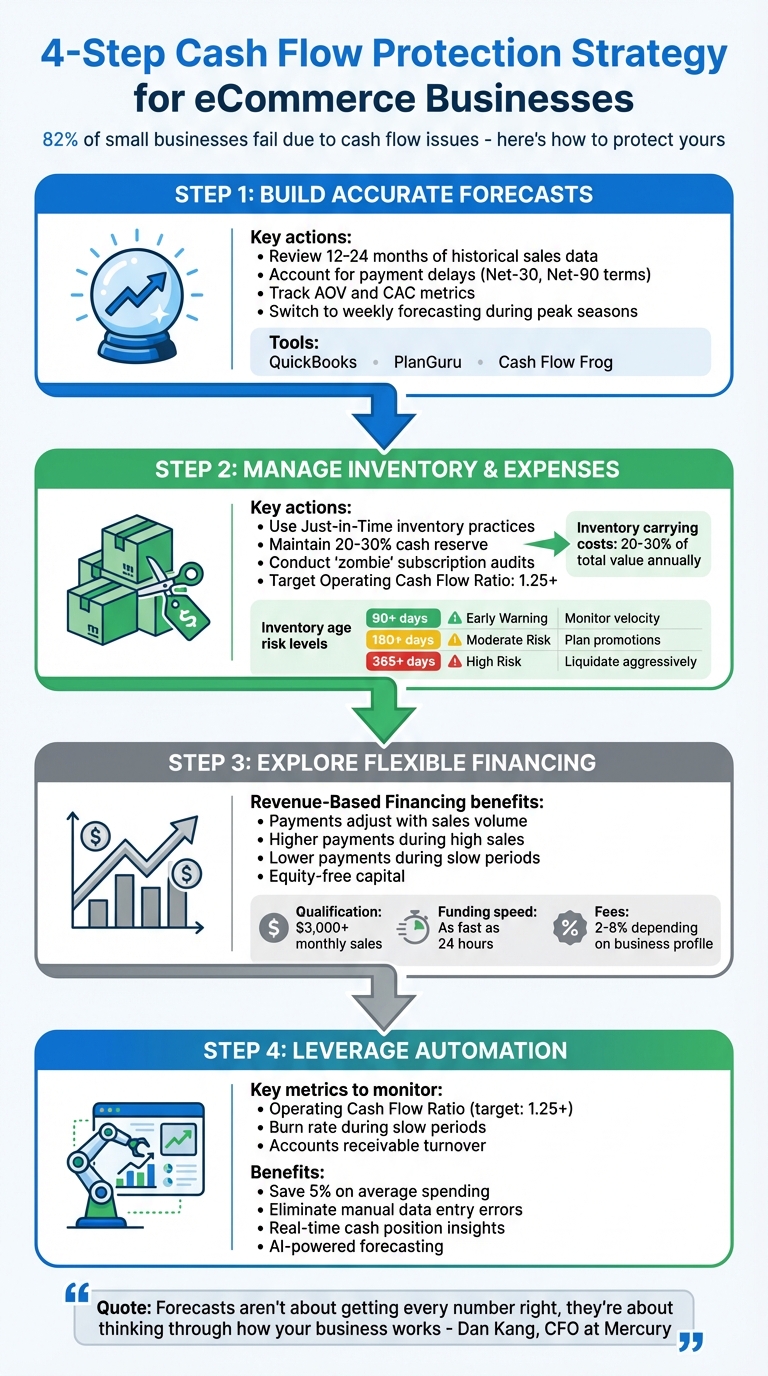
4-Step Cash Flow Protection Strategy for eCommerce Businesses
Cash flow management best practices for ecommerce entrepreneurs
Build Accurate Cash Flow Forecasts
To safeguard your cash flow, you need to know exactly when money is coming in and going out. Without a clear forecast, you risk costly mistakes [5]. Start by using your realized sales data as a foundation [4]. Dan Kang, CFO at Mercury, sums it up well:
"Forecasts aren't about getting every number right, they're about thinking through how your business works and what it needs to grow - plus how you can do that with fewer surprises and greater visibility" [4].
A solid forecasting process sets the stage for better handling of inventory, expenses, and financing decisions.
Review Historical Sales Data
Your business's past sales patterns can reveal a lot about its natural rhythm. Analyze the last 12–24 months to pinpoint periods of higher and lower revenue. For instance, you might notice a spike in November and December, followed by a January slowdown. Or maybe August tends to be quieter as customers take vacations.
Dig deeper into sales trends and customer retention to see how often customers return to make additional purchases [4]. This method is far more reliable than assuming steady growth every month. Don’t forget to account for payment delays - the gap between when a sale is made and when cash actually reaches your account. For example, if you offer Net-30 or Net-90 payment terms to wholesale buyers, your forecast must reflect this lag [3][5]. These details help you adjust for seasonal fluctuations and delayed payments.
Leverage historical metrics like Average Order Value (AOV) and Customer Acquisition Cost (CAC) as starting points, but be sure to adjust for current market conditions. During peak seasons, competition for advertising increases, which can drive up your CAC [4]. In high-demand periods, consider switching from monthly to weekly forecasting to stay on top of rapid inventory turnover and cash flow changes [5].
Account for Variable Expenses
Variable expenses - those that fluctuate with your sales volume - can create cash flow challenges if not anticipated. For eCommerce businesses, these include shipping fees, packaging materials, transaction charges, and advertising costs [5]. Sales surges often bring higher shipping and marketing expenses [5].
Review past financial records to understand how these costs scaled during busy periods [5]. For example, if shipping costs spiked during last year’s holiday season, factor that into this year’s forecast. Also, don’t overlook returns and restocking fees, which often increase after high-sales periods [2].
Another common issue is overstocking inventory. Avoid tying up cash in excess products that may not sell quickly, as this can leave you short on funds for other needs [3]. Use past sales velocity to determine safe inventory levels. Additionally, small businesses should aim to maintain a cash reserve of 20–30% to handle unexpected variable expenses [5].
Use Automated Forecasting Tools
Relying on manual spreadsheets can be both time-consuming and error-prone. Automated tools offer real-time insights into your cash flow, removing much of the guesswork. For simpler projections, tools like QuickBooks can generate 30-day and 90-day forecasts using your existing accounting data [6]. For more advanced scenarios, platforms like PlanGuru and Cash Flow Frog provide robust forecasting capabilities [6].
These tools automatically track and organize transactions from multiple sources, saving you from manual data entry and giving you a clearer picture of your cash position [3]. Businesses that use automated expense management solutions report saving an average of 5% on spending [3]. For eCommerce sellers, the Mercury eCommerce Forecast Model links customer acquisition, inventory planning, and financing decisions to outcomes like EBITDA and runway [4].
Consider creating multiple forecast versions - "Base", "Stretch", and "Conservative" - to prepare for different market conditions [4]. As Luis Gonzalez, Former Senior Content Marketing Manager at Ramp, puts it:
"With the right tools, you can forecast, measure, and control [cash flow]. Cash flow does not need to be another mystery" [3].
Manage Inventory and Operating Expenses
Once you've nailed down your forecast, the next move is figuring out how to handle your cash flow wisely. Two key areas where eCommerce sellers can quickly free up cash are inventory and operating expenses. As Chris Hondl, Engineering Lead at Finale Inventory, puts it:
"Excess inventory can strangle cash flow... these forgotten products represent frozen capital that could be fueling growth instead of collecting dust" [7].
Carrying inventory comes with steep costs - typically 20% to 30% of the total inventory value annually [7]. That’s money sitting idle when it could be used for things like marketing, hiring, or other growth-driving initiatives. On top of that, operating expenses can spiral out of control if you’re not careful, thanks to things like "subscription creep" and unnecessary recurring costs [3]. Keeping these expenses in check and aligned with your revenue is crucial to maintaining healthy cash flow. That’s why managing inventory and operating costs effectively is so important.
Use Just-in-Time Inventory Practices
Just-in-time (JIT) inventory is a smarter approach: order only what you need for the immediate cycle instead of stockpiling. This reduces the capital tied up in excess stock, turning dormant goods into resources to fuel growth [7]. Plus, it cuts down on warehouse-related costs, like rent, utilities, insurance, labor, and even Amazon FBA long-term storage fees. For reference, these fees kick in at 181 days (Tier 1) and skyrocket after 365 days (Tier 2) [7].
Another benefit? You can avoid steep markdowns. Liquidation brokers typically buy surplus inventory for just 10% to 30% of its retail value [7].
To make JIT work, start with a velocity analysis. Look at your 30/60/90-day sales patterns to spot trends and adjust orders before you end up with too much stock [7]. Work with suppliers to negotiate flexible minimum order quantities (MOQs) so you can break large orders into smaller, more frequent deliveries that match demand [7]. Also, consider redistributing inventory from slow-moving locations to areas with higher demand before placing new orders [7].
Here’s a quick framework to help you assess inventory risks and take action before your cash gets tied up:
| Inventory Age | Risk Level | Recommended Action |
|---|---|---|
| 90+ Days | Early Warning | Monitor velocity and forward cover days |
| 180+ Days | Moderate Risk | Plan promotions or bundle products |
| 365+ Days | High Risk | Liquidate aggressively or donate |
Once your inventory is under control, shift your focus to cutting unnecessary operating costs.
Focus on Required Business Expenses
Separate the must-have expenses from those you can scale back during slower periods. Many small businesses operate with thin profit margins, so there’s not much room for waste.
Start by conducting a "zombie" audit. Go through your monthly subscriptions and automated payments to cancel anything that doesn’t deliver a clear return on investment [3]. This could include unused software, duplicate marketing tools, or underperforming SEO or social media services [9]. It’s also worth negotiating with service providers - like web hosting or payment processors - for discounts or better terms. Many companies offer retention deals when you ask [9].
For labor, consider hiring contractors or third-party services during busy seasons instead of committing to full-time staff. This keeps your long-term overhead low during slower periods [2]. Use tools like automated expense tracking and virtual cards with vendor-specific spending limits to prevent overspending and make tracking easier [3]. And aim to keep a cash reserve covering 3–6 months of operating expenses to weather unexpected challenges [8].
Finally, keep an eye on your operating cash flow ratio. A healthy ratio for eCommerce businesses is 1.25 or higher, meaning you generate $1.25 in cash for every $1.00 of current liabilities [3]. This ensures you’re not just staying afloat but also building a buffer for growth.
sbb-itb-d7b5115
Use Financing Options for eCommerce Businesses
Once you've streamlined your inventory and tightened your expenses, tackling cash flow gaps becomes the next priority. Even with careful planning, cash flow challenges can linger, especially during seasonal slowdowns. This is where flexible financing options come into play, offering a way to bridge those gaps. Unlike traditional fixed bank loans - which can strain your finances during periods of low sales - flexible financing aligns with your revenue patterns, making it a better fit for eCommerce businesses dealing with fluctuating demand.
How Revenue-Based Financing Works
Revenue-based financing (RBF) offers a repayment model tailored to your sales. Instead of requiring a fixed monthly payment, RBF adjusts repayments based on your revenue. When your sales are high, you pay more; when sales dip, your payments decrease. This flexibility helps protect your cash flow during slower months while still providing the funds you need for critical business activities like stocking inventory, running ads, or preparing for seasonal demand.
Why is this so useful? Rapidly growing eCommerce businesses often face cash crunches because they need to invest in inventory ahead of sales [10]. For example, sellers may stock up in anticipation of a holiday rush, leaving them temporarily short on cash. With RBF, payments adjust to your sales, relieving pressure during low-revenue periods. As Onramp Funds explains:
"The easiest way to ensure you have sufficient seasonal cash flow is to have more cash" [2].
How to Qualify and Apply for Onramp Funds

Now that you understand RBF, let’s explore how Onramp Funds makes it accessible. Onramp Funds specializes in revenue-based financing for eCommerce sellers, integrating seamlessly with major platforms like Amazon, Shopify, BigCommerce, WooCommerce, Squarespace, Walmart Marketplace, and TikTok Shop. This integration allows them to analyze real-time sales data to determine your funding amount and repayment terms.
Getting started is straightforward. Head to Onramp's website to request an offer and review funding options tailored to your business. You can also schedule a call with their Austin-based team to discuss your specific cash flow needs. To qualify, your business must generate at least $3,000 in monthly sales. Once approved, funds can be available in as little as 24 hours, giving you quick access to capital for restocking inventory or ramping up ad campaigns during peak seasons. Repayments are made as a percentage of your sales, with fees typically ranging from 2% to 8%, depending on your business profile. The best part? Since this financing is equity-free, you retain full ownership of your business.
Use Cash Flow Management Tools
Tracking cash flow manually can quickly become overwhelming, especially when sales are unpredictable. That’s where cash flow management software steps in. These tools automate the tracking process and provide real-time insights into your financial position [3][12]. They consolidate data from multiple sources - like your bank accounts, eCommerce platforms such as Shopify or Amazon, and ERPs - into one central dashboard [11][12]. This integration ensures you have a clear and unified view of your cash flow, making it easier to monitor key financial metrics.
When combined with accurate forecasting and effective cost controls, these tools form a critical part of a strong financial management system.
Monitor Key Cash Flow Metrics
Keeping an eye on the right metrics is especially important during uncertain times. One key metric to track is your operating cash flow ratio (OCFR). This is calculated by dividing your cash flow from operations by your current liabilities. A healthy OCFR is typically 1.25 or higher, while a ratio below 1.0 could signal trouble in meeting financial obligations [3].
Another critical metric is your burn rate, which measures how quickly you’re using up capital during slower sales periods [3]. Monitoring this helps you plan better for lean months. Additionally, tracking your accounts receivable turnover ensures that unpaid invoices aren’t tying up cash you need for essentials like inventory restocking.
Modern tools make this process even easier by using AI to categorize transactions and forecast future cash flows based on historical patterns [11][12]. These tools also allow you to run "what-if" scenarios, helping you predict the financial impact of changes like fluctuating sales, inventory surges, or shifts in advertising budgets [12]. By focusing on these metrics and leveraging automation, you can simplify cash flow management and make more informed decisions.
Automate Repetitive Financial Tasks
Manual financial tasks not only eat up time but also leave room for costly mistakes. Automation eliminates these risks by handling repetitive processes like data entry, which helps prevent errors such as forgotten subscriptions or duplicate charges that quietly drain your cash reserves [3][5].
Some tools even offer virtual cards, allowing you to set spending limits for specific vendors or marketplaces. This feature is especially useful during uncertain periods, as it helps you avoid overextending your inventory budget [3].
David Eckstein, CFO at Vanta, highlights the benefits of automation:
"Ramp gives us one structured intake, one set of guardrails, and clean data end-to-end - that's how we save 20 hours/month and buy back days at close" [3][5].
Automation can also streamline tasks like invoice generation, payment scheduling, and sending collection reminders. These features help shorten your cash conversion cycle, ensuring money flows in and out efficiently. Many platforms even integrate with spreadsheets, so you can work within familiar tools while benefiting from live data updates [12].
Conclusion
Unpredictable sales cycles don’t have to throw your eCommerce business off course. By focusing on accurate cash flow forecasting, keeping expenses in check, and exploring flexible financing options, you can create a financial cushion that helps your business thrive during both high and low periods. This proactive mindset ties together all aspects of your cash management strategy.
With a staggering 82% of small businesses failing due to cash flow shortages, taking preventive steps is non-negotiable[1]. Financing options like revenue-based financing, which adjusts to your sales, can be a smart way to avoid financial strain during slower times[2]. These tools and strategies are critical for ensuring your business stays on solid financial ground.
As Luis Gonzalez, Former Senior Content Marketing Manager at Ramp, wisely said:
"Think of cash flow as the lifeblood that powers the heart of a business. Like a human heart, it flows in and out, giving the body vitality and energy to go about its daily activities"[3].
FAQs
What’s the best way to forecast cash flow for my eCommerce business?
To get a clear picture of your eCommerce business's cash flow, start by determining your current cash balance. Next, estimate your monthly income across all sales channels - this includes your website, marketplaces, and any other platforms where you sell. Don’t forget to factor in both fixed expenses (like rent or software subscriptions) and variable costs (such as inventory, shipping, and marketing).
It’s smart to plan for different scenarios - optimistic, realistic, and conservative - to see how fluctuations in sales or expenses might affect your cash flow. To calculate your net cash flow, subtract your total expenses from your income. Adjust these projections using historical trends and up-to-date data for more precise forecasting. Tools like financial management software or cash flow templates can simplify this process, offering real-time insights so you can better navigate unpredictable sales cycles.
What makes revenue-based financing a better option than traditional loans for managing cash flow?
Revenue-based financing offers a flexible repayment structure that adapts to your business's performance. Instead of sticking to fixed monthly payments, the amount you repay fluctuates with your revenue - higher payments during strong sales periods and lower payments when sales dip.
What sets this option apart from traditional loans is that it usually doesn’t require collateral or giving up equity in your business. For eCommerce sellers dealing with unpredictable sales patterns, this can be a practical and less risky way to manage cash flow.
How can just-in-time inventory management improve cash flow for eCommerce businesses?
Just-in-time (JIT) inventory management helps businesses keep their cash flow healthy by avoiding the expense of holding excess stock. Instead of stockpiling items, companies order inventory as it's needed to meet customer demand. This approach cuts down on storage costs, reduces the risk of products becoming outdated or unsold, and frees up funds for other critical needs or investments.
By syncing inventory levels with actual sales, JIT allows businesses to stay more liquid and adjust quickly to market shifts. This is particularly helpful during unpredictable sales periods, as it avoids overstocking and unnecessary spending, keeping eCommerce sellers financially flexible.
