

Invoice financing helps eCommerce businesses turn unpaid invoices into immediate cash, solving cash flow challenges caused by delayed customer payments. Here's how it works: lenders advance 70%-90% of an invoice's value upfront, charging fees typically between 1.5%-3% above benchmark rates. This allows sellers to cover expenses like inventory, marketing, or payroll without waiting weeks or months for payments.
Key Benefits:
- Fast Cash Access: Funds are often available within 24 hours.
- Simplified Approval: Focuses on customer payment reliability, not your credit score.
- Growth Opportunities: Use funds for inventory, marketing, or expansion.
Considerations:
- Costs: Fees can add up, with some reaching an annual percentage rate (APR) over 50%.
- Risk: If customers fail to pay, you may still be responsible (depending on terms).
- Customer Impact: Factoring might involve third-party collection, affecting relationships.
For eCommerce sellers, especially those working with B2B clients, invoice financing bridges the gap between delivering goods and receiving payment, ensuring smoother operations and growth potential. Platforms like Onramp Funds offer tailored solutions, integrating with eCommerce tools like Shopify and Amazon for easier workflows and flexible repayment options.
How Invoice Financing Works for eCommerce Sellers
The Application Process
Getting started with invoice financing is simple and entirely online. It begins with filling out an application and providing details about the invoices you want to finance. Many lenders have streamlined their processes, making it easy for busy eCommerce sellers to navigate.
You'll need to gather some basic documents, such as an ID, a voided business check, bank statements, and the invoices you’re looking to finance [2, 9]. Depending on how much funding you're seeking and the size of your business, additional financial documents might be required.
After submitting your application, the lender evaluates your business's stability and, most importantly, the reliability of your customers. Since repayment hinges on your customers settling their invoices, lenders focus heavily on their payment history [2, 3]. Once approved, you’ll typically receive 70%-90% of your invoice value upfront. When your customers pay their invoices, you repay the advance along with any applicable fees.
This process moves quickly, relying on both the documents you provide and the creditworthiness of your customers, which play a major role in determining eligibility.
Requirements and Qualifications
Unlike traditional loans, invoice financing prioritizes your customers' payment reliability over your business credit. To qualify, you generally need a history of issuing invoices to dependable, creditworthy customers who pay on time. Lenders prefer businesses that work with other businesses (B2B) rather than individual consumers, as this type of financing is tailored for B2B transactions.
Lenders will also look at several factors, including your customers' credit profiles, your business’s financial health, your average invoice size, and the industry you’re in. Even if your business credit score isn’t ideal, you may still qualify, as the focus is more on the strength of your invoices and your customers' payment track records. Ensuring your customers have a solid history of timely payments can help you secure better terms.
How Fast You Get Funded
One of the standout benefits of invoice financing is how quickly you can access funds. Unlike traditional loans, which often take weeks or even months to process, invoice financing can deliver funds in as little as 5–10 minutes. This speed allows eCommerce sellers to address pressing needs or take advantage of time-sensitive opportunities without delay.
Funds are often available almost instantly. As Paul Loftis, a small business owner, shared:
"Invoice Financing makes it easy for us small businesses and contractors to get the cash flow we need. It's instant. I mostly use it to help buy the materials. The prices of materials keep going up, so if I see a bunch of materials - like wiring or panels - at a store, I can just finance some invoices and buy them now."
– Paul Loftis, Loftis Lighting and Electrical
This rapid funding is especially beneficial during peak seasons or when suppliers offer short-term discounts. Instead of waiting weeks for customer payments, you can access the cash you need right away, ensuring your eCommerce business stays on track and meets its demands without missing a beat.
Invoice Factoring Vs Financing
Benefits of Invoice Financing for eCommerce
Understanding how invoice financing works is just the beginning. Let’s dive into why this financing option can be a game-changer for eCommerce sellers.
Better Cash Flow Management
One of the biggest hurdles for eCommerce businesses is managing cash flow, especially when waiting 30, 60, or even 90 days for customers to pay invoices. Invoice financing solves this by providing immediate access to funds, helping sellers cover critical expenses like supplier payments, payroll, rent, or inventory investments.
As your sales grow, so does your borrowing capacity, making it an adaptable solution for businesses with fluctuating revenue cycles. This flexibility is especially helpful during slower periods, allowing you to allocate resources wisely while maintaining timely payments to suppliers and employees. Prompt payments, in turn, can strengthen your credit profile.
Easier Approval Requirements
Unlike traditional loans that require extensive credit checks and financial reviews, invoice financing evaluates the creditworthiness of your customers rather than your business. This makes it an attractive option for newer eCommerce businesses or those with less-than-perfect credit histories.
"It offers a more accessible alternative to traditional loans, as the focus is on the creditworthiness of the customers rather than the business itself." – Credibly
The application process is straightforward and quick, saving you the hassle of gathering piles of documentation. With less time spent on paperwork, you can focus on running and growing your business. Plus, the streamlined approval process ensures you’re ready to act when opportunities arise.
Opportunities for Business Growth
Beyond stabilizing cash flow, invoice financing opens doors for expansion. With fast access to funds, you can take advantage of opportunities like bulk inventory discounts, seasonal demand surges, or marketing campaigns that require swift action. For instance, during peak seasons, you could stock up on inventory, hire temporary staff, and ramp up advertising to maximize sales.
Invoice financing also offers flexibility for strategic investments. By receiving cash advances as soon as invoices are issued, businesses can quickly respond to market opportunities, expand product offerings, or invest in technology upgrades without the constraints of traditional loans.
Take the example of Enness, which secured a $3.5 million facility for a thriving business with major contracts. This allowed the company to scale operations and manage working capital more effectively. As your sales and invoice amounts grow, so does your access to capital, creating a pathway for sustainable growth.
sbb-itb-d7b5115
Drawbacks and Risks to Consider
Invoice financing can be a helpful tool for businesses, but it’s essential to weigh the potential downsides before moving forward. Like any financial product, it comes with its own set of costs and risks that could impact your profitability.
Costs and Fees
One of the biggest concerns for eCommerce businesses is the cost structure of invoice financing. Unlike traditional loans with fixed interest rates, this option often involves multiple fees that can quickly add up. For example, factoring fees typically range between 1% and 5% of the invoice amount, while invoice discounting fees are generally lower, falling between 0.5% and 3% of the invoice value. While 1% may sound manageable, a weekly factor fee can translate into an annual percentage rate (APR) exceeding 50% when compounded over a year.
Other costs you might encounter include:
- Processing or application fees: These range from 1% to 5% of the advanced amount.
- Service fees: Ongoing charges for managing and administering the financing.
- Late payment fees: A percentage of the total outstanding invoice value if payments are delayed.
- Upfront charges: Typically 1% to 2% of the total loan amount.
- Annual fees: Around 0.5% to 1% of the loan amount.
To keep these costs under control, consider financing only high-value or long-term invoices when absolutely necessary. Offering small discounts to customers who pay early can also help reduce the need for financing. However, it’s worth noting that these fees and charges can become a significant burden, particularly if customers delay their payments.
What Happens When Buyers Don't Pay
Another major risk is what happens if your customers fail to pay their invoices. The consequences depend on the type of financing you choose.
With recourse factoring, you’re responsible for the unpaid invoice. This means you may need to repurchase or replace it, though the fees are typically lower. On the other hand, non-recourse factoring shifts the risk of non-payment to the financier, but this option usually comes with higher costs.
It’s also important to remember that factoring companies don’t just evaluate your creditworthiness - they’ll also look at the credit history of your customers. If many of your customers are newer businesses or have weaker credit profiles, you might face higher fees or even rejection.
Is Invoice Financing Right for Your Business?
Beyond the financial risks, it’s crucial to assess whether invoice financing aligns with your business model and goals. For instance:
- Businesses with very short payment terms may find the improvement in cash flow too minimal to justify the fees.
- If your invoices are typically small, the associated costs could take a significant bite out of your profits.
- When using invoice factoring, your customers will know a third party is handling collections, which could impact your relationships with them. Clear communication is key to avoiding misunderstandings.
Lastly, relying too heavily on invoice financing can sometimes mask deeper issues in your business, such as inefficient operations, weak pricing strategies, or slim profit margins. The recurring fees could create a cycle where you need additional financing just to cover previous costs. Before diving in, make sure you have a solid plan for how the funds will support growth and profitability. When used thoughtfully, invoice financing can be a valuable tool to boost working capital and seize new opportunities.
Invoice Financing Solutions for eCommerce Platforms
Traditional invoice financing often falls short for eCommerce sellers. Online businesses face unique challenges like rapid inventory turnover and seasonal sales spikes, requiring solutions designed to navigate the fast-moving digital marketplace.
Platform Integration and Simpler Workflows
Modern financing tools now integrate seamlessly with platforms such as Amazon, Shopify, Walmart Marketplace, TikTok Shop, BigCommerce, WooCommerce, and Squarespace. These integrations allow the systems to pull sales data directly, assess cash flow, and create funding offers tailored to your business - no need for tedious manual submissions.
This automation streamlines the entire process. Instead of spending hours gathering financial documents, the system analyzes your store’s sales trends and offers funding based on your actual performance. It’s a hands-off approach that lets you focus on running your business while the financing works quietly in the background.
One standout feature is the revenue-based repayment structure. Payments adjust automatically to match your sales cycles: you pay more during strong sales periods and less when things slow down. For eCommerce businesses with fluctuating revenues, this flexibility can be a game-changer.
This efficient approach has paved the way for specialized platforms like Onramp Funds, which cater specifically to the needs of online sellers.
Onramp Funds: A Custom Solution for eCommerce
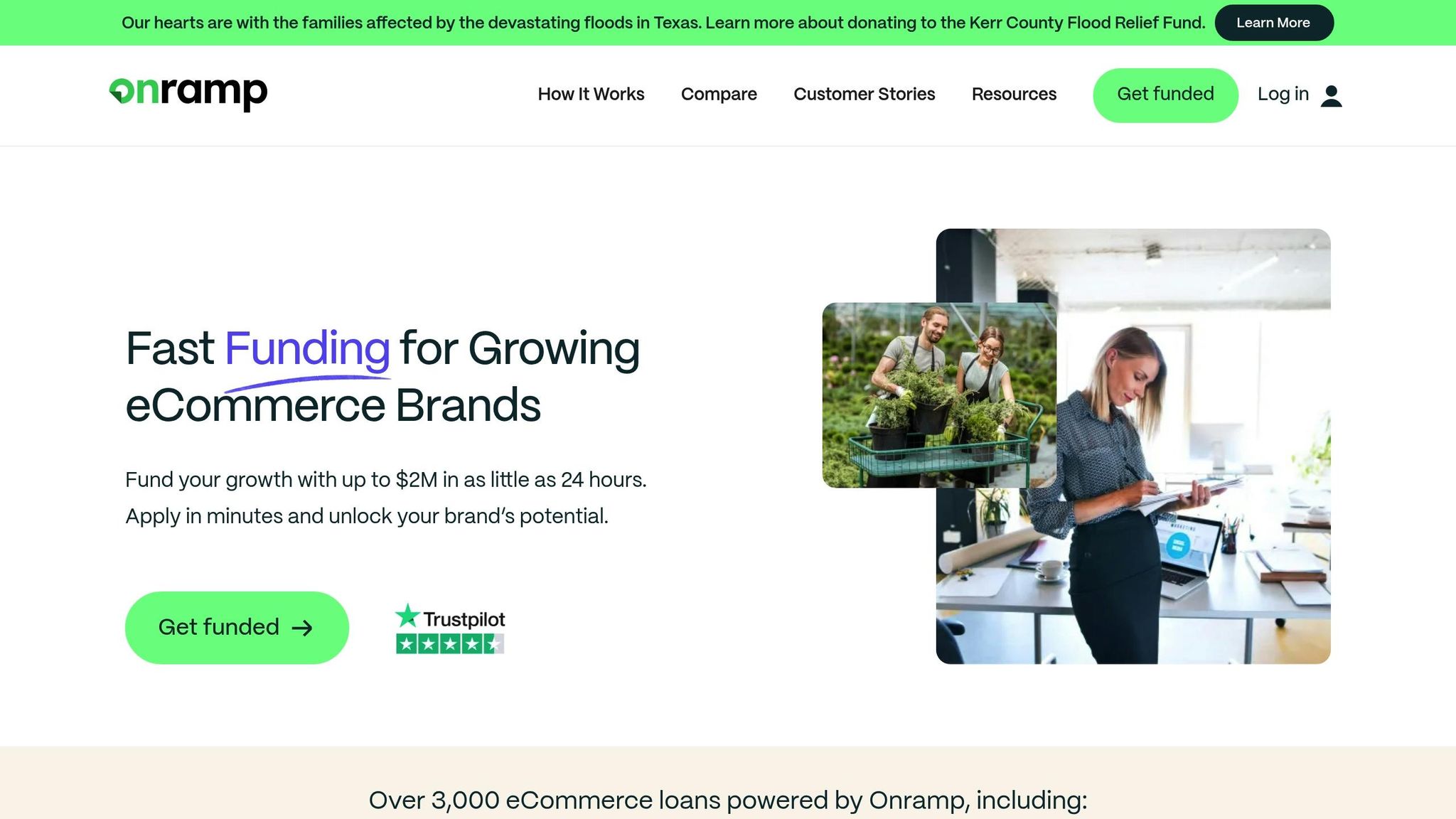
Onramp Funds addresses the cash flow challenges that eCommerce businesses frequently face, offering equity-free financing aligned with the unique cash cycles of online sellers. This means you can access growth capital without giving up ownership.
Speed is another key differentiator. Onramp provides funding in under 24 hours, enabling businesses to act quickly on opportunities.
"Applied, got our offer, and had cash in our bank account within 24 hours. Their Austin, TX based team was very professional and helped me deploy the cash to effectively grow our business", shares Nick James, CEO of Rockless Table.
What sets Onramp apart is its multiple funding offers. Instead of a single option, you receive several customized offers, allowing you to choose terms that best match your needs and repayment preferences.
The results are impressive: businesses using Onramp see an average revenue growth of 60%, and 75% of customers return for additional funding. This high repeat rate highlights the value of their flexible, sales-aligned repayment model.
Onramp Funds: Requirements and Features
To qualify, businesses need to meet just two criteria: at least $3,000 in average monthly sales and a legal U.S. business entity. There’s no requirement for a minimum business history.
Onramp offers two repayment options:
- Variable repayment: Payments are tied to a percentage of daily sales (starting as low as 1%), with no monthly minimums.
- Fixed repayment: Predictable, consistent dollar amounts for easier budgeting. Fees typically range between 2% and 8%, with no hidden costs.
"Onramp offered the perfect solution with revenue-based financing to secure the capital we needed to invest in inventory and pay it back at a reasonable time frame once we made sales. The process was fast with dedicated support", says Jeremy, Founder and Owner of Kindfolk Yoga.
The platform’s automation simplifies the financing process. As Torrie V., Founder and Owner of Torrie’s Natural, explains:
"Onramp has simplified cash flow by automating everything: easy to request, set it and forget it payments - quick and fast!"
In addition to its advanced technology, Onramp provides personalized support from their Austin-based team, ensuring you have access to expert guidance when needed. This blend of automation and human support creates a financing experience designed for the fast-paced eCommerce world.
Funds from Onramp can be used for a variety of purposes, including inventory purchases, shipping costs, marketing campaigns, or other growth initiatives. With repayment terms that align with your sales performance, Onramp Funds offers a practical and flexible alternative to traditional invoice financing, helping eCommerce sellers scale their businesses without giving up equity.
Key Takeaways
Main Benefits Summary
Invoice financing offers a practical way for eCommerce businesses to turn unpaid invoices into immediate cash. This quick access to funds can help with essential needs like restocking inventory or launching new products. A key advantage is the revenue-based repayment structure, which adjusts to your sales cycles. This means you can maintain steady cash flow, whether it's a busy season or a slower period.
While the costs of invoice financing - when converted to annual percentage rates - are often higher than traditional loans, the speed and ease of access can make it a worthwhile option for growing businesses. For B2B eCommerce sellers, it bridges the gap between shipping products and waiting for payments. This is especially helpful if you're offering credit terms to customers but need cash right away to cover operational expenses or replenish inventory.
Picking the Right Financing Partner
To fully leverage these benefits, choosing the right financing partner is essential for driving growth. Look for a provider that integrates seamlessly with your eCommerce platform, aligns with your business model, and offers clear, upfront pricing.
The ideal partner should provide smooth platform integration, flexible funding options, and pricing that takes into account your customers' payment behaviors. Your business model plays a big role in this decision. For instance, invoice financing is particularly effective for B2B eCommerce businesses that extend credit terms to their customers. On the other hand, if you're primarily a B2C seller, revenue-based financing solutions - like those offered by Onramp Funds - might be a better fit.
Speed is another critical factor in eCommerce. Markets move fast, and funding that can be accessed within 24 hours allows you to act on inventory deals, seasonal trends, or marketing opportunities without delay.
Lastly, take a close look at the total cost structure. While invoice financing may come with higher costs compared to traditional loans, the benefits of improved cash flow and growth potential can outweigh these expenses. A trustworthy financing partner will provide transparent pricing and ensure you understand what you're paying for - giving you clear access to your earned revenue and the opportunities it unlocks.
FAQs
What makes invoice financing different from traditional loans for eCommerce businesses?
Invoice financing gives eCommerce businesses a fast way to access cash by borrowing against unpaid invoices. It's a practical option for managing cash flow since repayments are tied directly to customer payments. Unlike traditional loans with fixed monthly payments and drawn-out approval processes, invoice financing adjusts naturally to the ups and downs of your sales.
While traditional loans often require collateral like property or other assets and come with strict repayment schedules, invoice financing is different. Here, your unpaid invoices serve as the collateral, which speeds up the approval process and reduces restrictions. This makes it a smart choice for eCommerce sellers who need funds for inventory, marketing, or scaling their business - without the stress of rigid repayment terms.
What risks should eCommerce sellers be aware of when using invoice financing, and how can they minimize them?
Invoice financing can be a useful option for eCommerce sellers, but it’s crucial to be aware of the risks that come with it. These risks include default risk (when customers fail to pay their invoices), recourse risk (where the seller might be held accountable for unpaid invoices), and fraud risk (such as dealing with fake or duplicate invoices).
To reduce these risks, sellers should take proactive steps like conducting thorough credit checks on their customers and establishing clear, detailed payment terms. Partnering with reputable financing providers that offer fraud detection and risk management tools is another smart move. Additionally, maintaining strong customer relationships and diversifying your client base can help lessen the reliance on a few key buyers, which in turn reduces the impact of possible payment defaults.
How does integrating invoice financing with platforms like Shopify or Amazon benefit eCommerce sellers?
Integrating invoice financing with eCommerce platforms like Shopify or Amazon streamlines the funding process by directly connecting your sales data to financing options. This automation cuts out the hassle of manual paperwork, making it quicker and easier to access funds.
With this setup, sellers can free up cash locked in receivables and put it to work - whether that's restocking inventory, boosting marketing efforts, or expanding their operations. By tying financing to real-time sales performance, it also adds flexibility and helps maintain a steady cash flow, enabling sellers to grow their businesses without unnecessary delays.
