

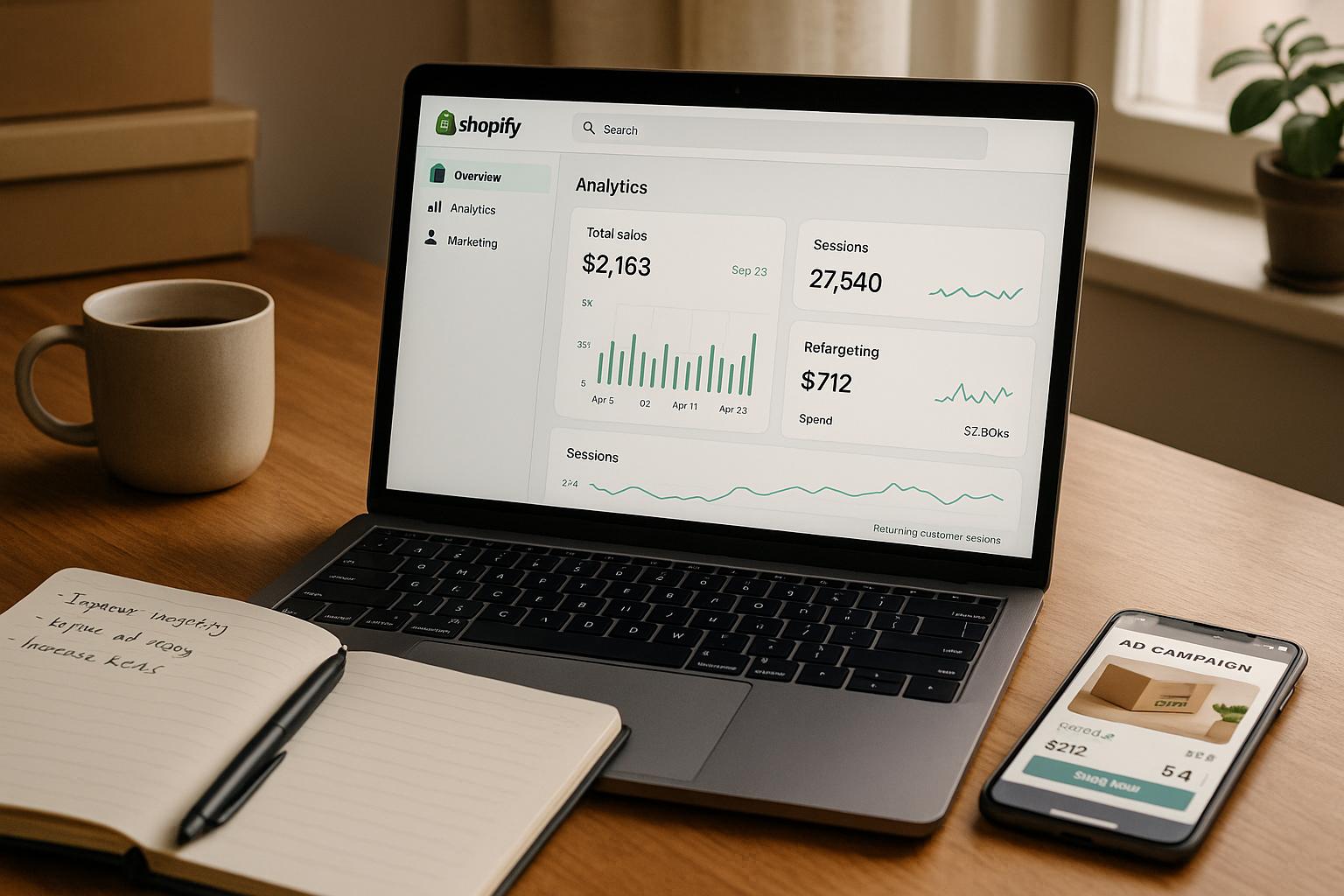
Did you know that 94.8% of Shopify visitors leave without buying? Retargeting is the solution. This approach targets people who’ve already shown interest in your products, making them 70% more likely to convert. Retargeting ads can boost conversions by up to 161% and deliver a lower cost per acquisition compared to standard ads.
Key strategies:
- Audience segmentation: Focus on cart abandoners, product viewers, past customers, and email subscribers for tailored campaigns.
- Budget allocation: Start with $20–$60 per segment daily, and adjust based on performance. A 70/30 split (new customers vs. retargeting) is common but can shift depending on your needs.
- Tools and platforms: Use Shopify Audiences, Meta Ads, Google Ads, and TikTok to refine targeting and maximize ROI.
- Performance monitoring: Track metrics like click-through rates, conversion rates, and cost per acquisition twice a week to optimize spending.
- Funding for growth: Revenue-based financing options like Onramp Funds provide quick capital for scaling successful campaigns, with repayments tied to sales.
Retargeting works by using personalized ads to re-engage potential buyers, driving higher engagement and better returns. With segmentation, precise budgeting, and the right tools, Shopify sellers can turn missed opportunities into sales.
"How to Use Retargeting Ads to Increase Shopify Store Sales - Effective Strategies"
What Is Retargeting and Why It Works
Retargeting is a marketing tactic aimed at reconnecting with visitors who interacted with your Shopify store but left without completing a purchase. Instead of broadcasting messages to a broad audience, retargeting hones in on people who have already shown interest in your products, making it a more focused and effective strategy. Essentially, it serves as a gentle nudge to remind previous visitors of what caught their attention.
This precision is what makes retargeting stand out compared to traditional advertising methods.
How Retargeting Works
The mechanics of retargeting reveal why it consistently delivers better results. By using tracking technology, it identifies visitors who browse your site, view specific products, or abandon their shopping cart. Later, it serves them personalized ads to re-engage their interest.
- Pixel-based retargeting: This method relies on a small piece of code, or "pixel", embedded in your website. The pixel places cookies on visitors' browsers, enabling platforms like Google Ads, TikTok, and Meta to follow their online activity. As these users navigate other websites or social media, they’re shown ads featuring the products or categories they explored on your site.
- List-based retargeting: Here, you leverage customer data you already own, such as email addresses. By uploading this information to advertising platforms, you can target users who match that data with tailored ads. This approach is especially effective for promoting new products or special offers to your existing customers.
For example, someone who browsed a specific product might later see an ad featuring that exact item. Similarly, a shopper who abandoned their cart could receive a reminder to complete their checkout. Understanding these methods is key to allocating your marketing budget effectively.
Why Retargeting Gets Better Results
Retargeting consistently outperforms many other advertising strategies. Users targeted through retargeting are 43% more likely to convert than first-time visitors, and campaigns often achieve a 50% lower cost per acquisition compared to traditional search ads. In fact, 92% of marketers agree that retargeting delivers stronger results than other ad techniques.
Here’s why it works so well:
- Building trust through repeated exposure: Retargeting taps into the "mere-exposure effect", a psychological principle where repeated interactions with a brand increase familiarity and trust.
- Personalized ads boost engagement: Retargeting ads often reference a shopper’s previous activity, showcasing the exact products they viewed or similar recommendations. Dynamic retargeting, which tailors ads to individual preferences, can triple conversion rates compared to generic ads.
- Timely reminders match buying intent: Retargeting reaches potential buyers at the right moment. Data shows that 56% of shoppers return to complete a purchase within a week of seeing a retargeted ad.
- Higher engagement rates: Retargeting campaigns achieve an average click-through rate of 0.7%, nearly 10 times higher than standard display ads. Additionally, retargeted users are three times more likely to interact with an ad compared to cold audiences.
Take Mac Duggal, a luxury women’s apparel brand, as an example. By utilizing Shopify Audiences for retargeting, they expanded their audience size by 2.3 times. This strategy helped them double their return on ad spend and reduce their cost per purchase by 3.6 times.
Emily Greenfield, Mac Duggal’s ecommerce director, shared:
"While it was harder to get strong performance out of ads as a result of digital industry changes, Mac Duggal is now able to target more effectively and more efficiently through Shopify Audiences. The solution allows us to reach new potential shoppers that are worth targeting."
Retargeting isn’t limited to ads. Retargeting emails, for instance, achieve an impressive 45% open rate - significantly higher than standard marketing emails. By combining ads with email campaigns, you can ensure your message reaches customers wherever they spend their time online.
How to Segment Your Retargeting Audiences
Segmenting your retargeting audiences wisely can help you get the most out of your ad spend by focusing on groups based on their behavior and interests. This strategy not only boosts your ROI but also provides insights for better budget allocation in future campaigns.
Personalization plays a huge role in success: 71% of consumers expect personalized experiences, and 76% feel frustrated when that expectation isn’t met. Considering that only 5.2% of ecommerce traffic converts on average, dividing your audience into meaningful segments becomes essential to maximize your retargeting efforts.
Main Retargeting Audience Types
To start, identify the key groups in your audience. Each segment needs a tailored approach, with budgets adjusted based on their likelihood to convert and their stage in the buying process.
- Cart abandoners: These are your most valuable prospects. They’ve already picked products and started checkout, showing clear intent to buy. Since their interest is fresh, they need immediate attention, often with a smaller budget. For example, FUNNYFUZZY used Shopify’s cart recovery tools to boost its conversion rate by over 40%.
- Product viewers: These are visitors who checked out specific items but didn’t add them to their cart. A gentle nudge, like ads featuring the products they browsed, combined with social proof or limited-time offers, can encourage them to act.
- Past purchasers: Customers who’ve already bought from you are great candidates for cross-selling or upselling. You can segment them further by how recently they purchased, how much they spent, or the types of products they bought.
- Email subscribers: If you have subscribers who haven’t made a purchase yet, offer them exclusive deals to encourage their first order.
- First-time visitors: Allocate part of your budget to this group to build awareness and introduce them to your brand.
- Geographic segments: Customize ads based on location, including local languages, currencies, and shipping options.
- Time-based segments: Tailor your campaigns depending on how long it’s been since the customer’s last interaction. Recent visitors may just need a reminder, while those who haven’t engaged in weeks might respond better to stronger incentives.
Tools for Better Audience Targeting
Several tools can help you refine your audience targeting and make the most of your retargeting campaigns:
-
Shopify Audiences: A standout tool for Shopify sellers, it uses first-party data to create highly targeted segments. Shopify Audiences can double retargeting conversions for every dollar spent and reduce customer acquisition costs by up to 50%. For instance, Mac Duggal, a luxury women’s apparel brand, used Shopify Audiences to build a 2.3x larger retargeting audience, double their ROAS, and lower their cost per purchase by 3.6x. Emily Greenfield, Mac Duggal’s ecommerce director, shared:
Note: Shopify Audiences is free for Shopify Plus merchants using Shopify Payments in the US or Canada."While it was harder to get strong performance out of ads as a result of digital industry changes, Mac Duggal is now able to target more effectively and more efficiently through Shopify Audiences. The solution allows us to reach new potential shoppers that are worth targeting."
- Web analytics platforms: These tools provide insights into visitor behavior, such as which pages they view, how long they stay, and what actions they take before leaving.
- Email signup forms: Use these forms to let customers self-segment by including questions about their preferences and interests.
- Social media advertising platforms: Platforms like Meta Ads let you create audiences based on users’ social media profiles. You can layer demographic and interest-based targeting on top of behavioral data.
One key to effective segmentation is excluding customers who’ve already completed the action you’re promoting. This ensures you’re not wasting ad spend on people who no longer need encouragement and allows you to focus on those who still might convert.
A great example of segmentation success comes from Propeller Coffee Co. Aaron Zack, the company’s former vice president, explained their approach:
"We look at customer segmentation analysis in terms of product mix, purchase rate, AOV, LTV, and abandoned cart rate to get an understanding of how people are making purchases or not."
By using this data to create customized messages, Propeller Coffee Co. achieved a 175% increase in email marketing conversions.
Finally, segmentation isn’t just about driving immediate sales. Reza Khadjavi, founder of Shoelace, offers this perspective:
"Don't always feel the need to get somebody to buy something. You can use a retargeting campaign to get them to sign up to your email list, because then it's free for you to reach out to them any time you want."
Setting and Managing Your Retargeting Budget
Once you’ve segmented your audience, the next step is setting and managing your budget to ensure each group gets the attention it needs. Start with a cautious approach, then scale up based on performance data.
Starting Budget for Each Audience Segment
For initial campaigns, allocate a daily budget of $20–$60 per segment. This range strikes a balance between gathering useful data and minimizing financial risk.
Your budget should reflect the size and potential of each audience. For example, smaller, high-intent groups - like users who abandoned their carts - might require a smaller budget. On the other hand, broader audiences, such as all website visitors from the last 180 days, will need a larger allocation to make an impact. Tools like Facebook Ads Manager can help you estimate audience sizes and adjust budgets accordingly.
A popular guideline is the 70/30 rule: dedicate 70% of your ad spend to attracting new customers, and 30% to retargeting. However, if your site already sees significant traffic but struggles to convert leads, a 50/50 split might deliver better results.
Jake Newbould, Head of Digital Marketing at Piglet, shares their approach to retargeting mid-funnel audiences:
"In our middle-of-the-funnel retargeting, our copy aims to showcase our unique selling propositions or brand origin story in a succinct, easy-to-digest way. We're trying to persuade already-engaged customers why you should buy Piglet products over our competitors."
Once your initial budgets are in place, keep a close eye on performance to fine-tune your spending.
Tracking Performance and Making Adjustments
To avoid wasting money, review key metrics at least twice a week. Focus on data such as website clicks, reach, click-through rate (CTR), cost per click (CPC), and how your total ad spend aligns with your goals.
The cost of acquiring customers (CAC) has risen by 60% over the past five years, making it crucial to measure CAC against customer lifetime value (CLV).
Arthur Korniyenko, Founder and CEO of GenovaWebArt, highlights the importance of tracking:
"Tracking your retargeting ads' performance is crucial to making future campaigns more efficient. Handle data analysis for metrics like click-through rates, conversion rates, return on investment (ROI), customer acquisition cost (CAC), and customer lifetime value (CLV)."
Adjust budgets based on how your ads are performing. For instance, if you notice the same audience is seeing your ads too often, consider reducing your spend or expanding your targeting to avoid ad fatigue. Frequency caps can help keep your ads impactful and engaging.
When you see strong conversion rates and a healthy return on ad spend (ROAS), consider gradually scaling your budget. If costs start climbing without a corresponding boost in conversions, pull back and reassess.
A/B testing is a powerful tool for budget optimization. Test different ad formats, visuals, headlines, and calls to action to see what resonates most with each audience. Shift more funds toward the winning combinations and pause those that underperform.
Keep an eye on performance as you increase budgets. Ads that work well at $30 per day might not perform as effectively at $100 per day due to audience saturation or algorithm changes. Regular adjustments will help maintain profitability.
Conduct weekly reviews to identify which audience segments deliver the best results. Reallocate funds as needed to ensure your retargeting budget is working as efficiently as possible. This continuous refinement can make a big difference in maximizing your ROI.
sbb-itb-d7b5115
Creating Ads and Choosing Platforms
Once you've set up your segmented budget strategy, the next step is to create ads that convert and pick the right platforms to connect with your audience. Your ad content should reflect how users interact with your site, and you’ll want to focus on platforms where your customers are most active. The goal? Ads that feel personal and relevant to their browsing behavior.
Crafting Ads That Align with User Behavior
The best retargeting ads are like a gentle nudge, reminding users of products they’ve already shown interest in. Dynamic product ads are particularly effective here - they automatically showcase the exact items someone viewed or added to their cart. This tailored approach makes the ad feel purposeful rather than random.
Brands like Madewell and Fossil use dynamic product ads to highlight recently viewed items, often paired with perks like free shipping to encourage purchases. But it’s not just about showing products - your ad copy should match the user’s stage in the buying journey. For instance:
- For cart abandoners: Use messages like "Still deciding?" or "Your items are waiting for you."
- For casual browsers: Focus on your brand’s unique value or story to pique their interest.
Adding a sense of urgency can also motivate hesitant shoppers. J.Crew Factory, for example, created a striking ad featuring a countdown clock with a bold "40% off" offer and the tagline "The clock is ticking". Social proof can further build trust - Mott & Bow includes customer reviews in their Facebook retargeting ads, tailoring the feedback to resonate with different audiences. And don’t forget a clear, compelling call-to-action. Campaigns like RedBalloon’s use gentle reminders to bring shoppers back to their carts and complete their purchases.
To keep things fresh, set frequency caps and rotate your ad creatives regularly.
Best Retargeting Platforms to Use
With your behavior-driven ads ready, the next step is choosing platforms that maximize their impact. Each platform has its strengths, so using a mix can help you reach your audience wherever they spend their time.
- Facebook and Instagram: These platforms excel at visual storytelling, making them perfect for engaging users during their downtime. Facebook’s custom audience tools let you segment users based on website behavior, so you can tailor ads specifically for cart abandoners or casual browsers.
- Google Ads: A great choice for targeting users with high purchase intent. Google’s retargeting options include placements on partner websites and YouTube, making it ideal for product-focused campaigns.
- TikTok: If you’re looking to engage younger audiences, TikTok is a growing player in the retargeting space. Its native, video-based ad formats allow for creative storytelling that feels natural on the platform.
- Shopify Collabs: For Shopify sellers, this tool enables influencer-driven campaigns, boosting your retargeting efforts with trusted voices.
There are also tools to help simplify retargeting across multiple platforms. For example:
- AdRoll: Manages email and display campaigns across social media, native ads, and other networks.
- Adwisely: Automates ads on Facebook, Instagram, Google, and TikTok, using AI to optimize performance.
Start with one or two platforms where your audience is most active, and expand as you see results. Typically, Google Ads and Facebook are strong starting points due to their robust retargeting features and large user bases.
Finally, don’t overlook the power of retargeting to grow your email list. Building an email list gives you a cost-effective way to maintain ongoing engagement. Retargeting ads are 76% more likely to get clicks than standard display ads, and retargeted users are 70% more likely to convert. Investing time and effort into creating high-quality ads and choosing the right platforms can pay off in a big way.
Growing Your Retargeting Budget with Funding
Retargeting campaigns are known for delivering impressive results, but they require consistent investment. For Shopify sellers, this creates a tricky cycle: you need funds to drive sales, but you also rely on sales to secure those funds.
The revenue-based financing market has grown tremendously, jumping from $901.41 million in 2019 to an estimated $42.3 billion by 2027, with an annual growth rate of 61.8%. This surge highlights the increasing demand for quick and adaptable funding options.
Using Onramp Funds for Marketing Investments
Traditional bank loans often involve long approval processes, extensive paperwork, and personal guarantees. For Shopify sellers who need to act fast - whether it’s to capitalize on seasonal trends or scale a successful campaign - this process can be too slow. That’s where revenue-based financing comes in, offering a faster and more flexible alternative.
Onramp Funds, for example, provides funding within 24 hours. This allows sellers to immediately scale their retargeting budgets when campaigns show strong performance. The repayment model is tied directly to daily sales, with approvals based on your store’s real-time metrics like monthly revenue, ad performance, and customer reviews. Even if your credit score isn’t perfect or your business is relatively new, a profitable Shopify store with solid retargeting results can still qualify for funding.
"Revenue-based financing is often a far more compelling proposition for Founders than venture capital or business loans... Because, primarily, Founders get to keep full ownership of their business rather than giving up equity - as is the case with venture capital - and there is no risk of default as there is with a loan." - Michele Romanow, president and co-founder of Clearco
With funds available almost instantly, sellers can reinvest in platforms like Meta, TikTok, and Google, scaling campaigns that are already delivering results - without waiting for cash flow to catch up.
Flexible Repayment for Better Budget Management
Quick access to funds is only part of the equation. Managing repayment terms is equally important for maintaining campaign growth. One of the standout benefits of revenue-based financing is its flexibility: repayments are based on a percentage of daily sales, rather than fixed monthly amounts. This means that during slower periods, your repayments decrease, easing the strain on your cash flow.
"Unlike traditional debt financing such as bank loans, revenue-based financing solutions are tailored to your working capital cycle, and remittances are based on a percentage of your daily sales. If sales aren't very high, the amount collected will be lower, so there's less impact on your cash flow." -
This structure is especially helpful during seasonal shifts or when testing new campaigns. As sales increase, so do repayments, ensuring that the cost of financing aligns with the revenue generated by your marketing efforts. Many small business owners find this model practical and manageable. As Maria Gonella, Managing Partner at Quantum Group, shared:
"For a small shop owner like me, having financing that goes up and down with my sales. This responsive financing model proves practical for small shop owners." - Maria Gonella, Managing Partner at Quantum Group, Quantum Jobs USA
Revenue-based financing typically comes with a flat fee of 2% to 12% of the advanced amount. To make this model work, your retargeting campaigns need to deliver returns that exceed these costs. Given that retargeted users are 70% more likely to convert and retargeting ads receive 76% more clicks than standard display ads, the potential for profitability is high - especially when scaling campaigns that are already successful.
This financing approach has also been a game-changer for women entrepreneurs. Some providers report funding 25 times more women-owned businesses than traditional venture capital. By focusing on business performance rather than rigid criteria, revenue-based financing opens doors for a diverse range of sellers to access the funds they need to grow.
Key Points for Retargeting Budget Success
To make the most of your retargeting efforts, focus on three essential principles: smart audience segmentation, consistent performance monitoring, and strategic funding to scale what works.
Starting with audience segmentation, tailoring your campaigns to specific customer behaviors is crucial. Segmented campaigns have been shown to increase conversion rates by 147% and ROI by up to 200%. Instead of running the same ad for everyone, create targeted segments based on customer actions. This approach not only delivers more relevant messages but also minimizes wasted ad spend.
Next, performance monitoring ensures your campaigns stay profitable. Keep a close eye on key metrics like CTR, conversion rate, CAC, and CLV at least twice a week. Regularly reviewing these numbers helps you identify which segments and creatives are performing well. Use these insights to adjust your targeting and test different offers or messages for each audience group.
Finally, strategic funding can help you overcome cash flow challenges. For example, Onramp Funds provides capital within 24 hours, with repayments tied to daily sales. This flexibility allows you to quickly scale up budgets for high-performing campaigns. With 75% of customers borrowing again and seeing 73% revenue growth within 180 days, this type of funding can accelerate your retargeting success.
Retargeting works best when treated as a dynamic, data-driven strategy. Remember, retargeted customers are three times more likely to click on ads compared to cold audiences. By focusing your budget on high-converting segments, monitoring performance regularly, and using flexible funding to scale, you can drive long-term growth.
FAQs
How can Shopify sellers allocate their retargeting budgets effectively across different audience segments?
To make the most of your retargeting budget, Shopify sellers should consider starting small - somewhere between $20 and $60 per segment - and then tweak spending based on key performance indicators like click-through rates and conversions. Focus on high-value customer groups, such as those who frequently make purchases or tend to buy higher-ticket items, as these segments often yield a stronger return on investment.
Audience segmentation is crucial. Break your audience into groups like cart abandoners, past customers, or general website visitors, and craft ad content that speaks directly to their behaviors and preferences. This level of personalization not only grabs attention but also ensures your budget is being used efficiently. Regularly tracking and refining your campaigns will help you zero in on the most lucrative opportunities.
For sellers ready to expand their marketing efforts, Onramp Funds provides quick and flexible funding tailored for eCommerce businesses. With repayment options tied to your revenue, you can confidently invest in areas like inventory or advertising while keeping your cash flow steady.
What are some effective ways to create personalized retargeting ads that connect with potential customers?
To craft retargeting ads that genuinely connect with your audience, it’s all about personalization. Start by segmenting your audience based on their actions - whether they’ve browsed specific products, left items in their cart, or made a purchase. This way, you can serve ads that feel relevant and timely.
Take advantage of dynamic ad content to spotlight products or services your audience has already shown interest in. Sweeten the deal with incentives like free shipping or limited-time discounts to nudge them toward completing a purchase. And don’t forget - your visuals and copy should be both engaging and consistent with your brand’s voice to create a deeper connection.
If you’re a Shopify seller aiming to grow your marketing efforts, tools like Onramp Funds can help. They offer flexible, sales-based repayment options, making it easier to invest in retargeting campaigns that deliver results.
How can revenue-based financing from Onramp Funds help Shopify sellers optimize their retargeting budgets?
Revenue-based financing from Onramp Funds gives Shopify sellers the flexibility to manage their retargeting budgets without the stress of rigid payment schedules. Instead of requiring fixed monthly payments, the repayment adjusts according to your revenue. When sales slow down, payments decrease; when business is booming, they increase. This setup helps you maintain steady cash flow while still investing in impactful retargeting campaigns.
With repayments tied to your store's performance, you can allocate more funds to retargeting during high-sales periods, boosting your ROI and driving business growth - all without the pressure of traditional fixed-payment loans. This flexible model allows you to scale your marketing efforts in a way that aligns with your store's success.
