


Low-impact financing is reshaping how eCommerce businesses manage funding, offering solutions specifically designed for the fast-paced, unpredictable world of online sales. Unlike traditional loans with rigid terms, these financing options align repayments with sales performance, providing flexibility during both high and low sales periods. Here's what you need to know:
- What It Is: A model where repayments adjust based on revenue, ensuring businesses only pay more when they earn more.
- Why It Matters: eCommerce businesses face challenges like seasonal sales fluctuations, upfront inventory costs, and cash flow gaps. Low-impact financing addresses these issues with faster approvals, fewer requirements, and repayment structures that fit real-time sales.
- Popular Types:
- Revenue-Based Financing: Repay a percentage of sales, ideal for growth-focused investments.
- Inventory Financing: Use inventory as collateral to free up cash for restocking.
- Short-Term Bridge Funding: Quick funding for immediate needs, like seizing time-sensitive opportunities.
eCommerce Funding Secrets Every Seller Should Know
Types of Low-Impact Financing for eCommerce Businesses
Finding the right financing can be a game-changer for eCommerce businesses looking to grow sustainably. Different types of low-impact financing are suited to specific needs, and understanding these options can help you make smarter financial decisions. Here are three of the most commonly used financing methods in eCommerce.
Revenue-Based Financing
Revenue-based financing (RBF) is gaining traction fast. In fact, it's projected to grow from $6.4 billion in 2023 to an impressive $178.3 billion by 2033 [6]. The appeal lies in its repayment structure - payments are tied to a percentage of your monthly revenue. When sales are strong, repayments increase; when sales dip, payments decrease. This makes RBF a flexible option that aligns with your business's performance.
This financing method is great for expanding product lines or funding marketing campaigns [6]. Costs typically range from 6% to 12% of the loan amount, which is far more affordable than merchant cash advances, where costs can soar to 30% or even 40% [2]. However, RBF does come with some limitations. To qualify, your business needs consistent revenue, and the loan amounts may be smaller compared to traditional financing [6]. If your sales are highly unpredictable, you'll need to carefully assess how much revenue you can afford to share [4].
RBF is a versatile tool for businesses looking to support growth without taking on rigid financial obligations.
Inventory Financing
Inventory financing is specifically designed to tackle one of the biggest challenges in eCommerce: cash tied up in unsold stock. By using your existing inventory as collateral, this type of financing makes it easier to buy in bulk, meet seasonal demand, and avoid stock shortages [5].
This option is particularly useful when you need to quickly restock to handle a sudden surge in demand or manage seasonal fluctuations. However, there are some risks. If you can’t repay the loan, you could lose your inventory. Plus, the due diligence process can be both costly and time-intensive [5]. Another limitation is that the funds can only be used for inventory purchases, so they won’t cover broader business needs [5].
For businesses that need quick cash, short-term bridge funding might be a better fit.
Short-Term Bridge Funding
Short-term bridge funding is all about speed and flexibility. It’s ideal for covering immediate expenses or seizing time-sensitive opportunities without committing to long-term financing.
Whether you’re looking to take advantage of limited-time discounts on inventory or need to cover operational costs during a temporary cash flow gap, bridge funding provides quick access to capital. Its short-term nature ensures you won’t be tied to extended repayment obligations, making it a practical option for urgent needs.
Stephen Brown offers a key piece of advice when considering financing options:
"For a good price on your capital, keep transparent finances." [3]
eCommerce businesses often combine these financing methods at different stages of growth. Revenue-based financing supports ongoing expansion, inventory financing strengthens purchasing power, and bridge funding handles short-term cash flow challenges. By understanding when and how to use each option, you can set your business up for long-term success.
Benefits and Drawbacks of Low-Impact Financing
Smart financing is all about balancing the benefits against the risks. For eCommerce sellers, the unique challenges they face make it crucial to understand how low-impact financing can address their needs.
Main Benefits of Low-Impact Financing
One of the standout advantages of low-impact financing is its flexible repayment structures. These adapt to your business's revenue, unlike traditional loans with fixed monthly payments. When sales are booming, you pay more; during slower periods, your payments decrease. This flexibility is especially valuable for managing seasonal ups and downs, which are common in eCommerce.
Another major perk is the speed and accessibility of this financing option. Traditional loans often involve drawn-out approval processes, which can leave eCommerce sellers waiting. Low-impact financing, on the other hand, offers faster and simpler access to funds.
By syncing payments to revenue, this financing also helps with cash flow management. Instead of stressing over fixed payments during slow months or unexpected downturns, you can focus on scaling your business.
Lastly, many low-impact financing options come with no collateral requirements. This means you don’t have to put up assets to secure funding, allowing you to retain full ownership of your business.
Potential Drawbacks to Consider
The biggest downside? Higher costs. The flexibility and quick access to funds often come with steeper fees and rates compared to traditional loans. This premium can cut into profits, so it’s important to weigh these costs against your growth goals.
While low-impact financing has different eligibility requirements, they still exist. For example, revenue-based financing often demands a steady sales history, which newer businesses might not have yet. According to Goldman Sachs, "77% of small business owners are concerned about their access to capital" [7], showing how challenging it can be to secure funding.
Another risk is overleveraging, which happens when businesses take on too much financing. Smaller businesses, often operating with tight margins, can find themselves in a tough spot if they overextend. Proper financial planning is key to avoiding this trap.
External financial pressures also come into play. The Federal Reserve reports that "54% of surveyed businesses said that higher interest rates have led to increased costs/payments on debt" [7]. Additionally, eCommerce businesses face unique risks, such as losing over $40 billion to payment fraud in 2022 alone [8].
Finally, limited loan amounts can be a constraint. While low-impact financing works well for gradual growth and day-to-day operations, it may not cover the costs of major expansions or significant inventory investments.
Financing Models Comparison Table
Here’s a quick look at how different financing models stack up in terms of benefits and limitations:
| Financing Model | Advantages | Limitations |
|---|---|---|
| Revenue-Based Financing | Flexible payments tied to sales performance | Requires a proven sales history |
| Inventory Financing | Unlocks cash for restocking inventory | Risk of overstocking, reliant on inventory value |
| Bridge Funding | Quick access to funds for immediate needs | Short-term solution, not ideal for long-term growth |
The secret to success is choosing the financing model that best fits your business’s current needs and future goals. Many eCommerce businesses combine these options to make the most of their strengths while staying mindful of the limitations. Knowing these trade-offs is essential for crafting a smart growth strategy.
sbb-itb-d7b5115
How to Use Low-Impact Financing for Growth
Once you've grasped the benefits of low-impact financing, the next step is figuring out how to use it to fuel measurable growth. Success lies in understanding your business needs, utilizing platform integrations, and adopting smart scaling strategies.
Evaluating Your Business Needs
The first step is identifying where financing can make the biggest impact. For example, cash flow gaps are a common issue. Maybe you're waiting 30 days for Amazon payments, but your supplier wants payment in 15 days. Or perhaps you're dealing with seasonal inventory buildups that stretch your working capital thin.
Pin down exactly how much funding you need, what you'll use it for, and how repayment terms align with your cash flow. According to a Goldman Sachs survey, over 75% of small business owners cited limited access to funding as a major barrier to growth [1].
Match the financing type to your goals. If you're stocking up for the holiday season with predictable sales, inventory financing might be the right move. On the other hand, for longer-term projects like expanding into new marketplaces or launching products, revenue-based financing offers more flexible repayment options tied to your success.
Do the math: factor in all costs, including fees, and make sure your expected returns outweigh the expense. For instance, if you’re projecting a 40% margin on new inventory but financing eats up 15% of your revenue, ensure the expected sales volume justifies the cost.
Once you’ve outlined your financing needs, the next step is integrating these solutions into your eCommerce platforms.
Connecting Financing with eCommerce Platforms
Modern financing solutions shine when they integrate directly with your existing systems. These integrations reduce manual data entry, minimizing errors and speeding up funding decisions.
Many revenue-based financing providers connect seamlessly with platforms like Amazon, Shopify, BigCommerce, WooCommerce, Squarespace, Walmart Marketplace, and TikTok Shop. This connection allows lenders to pull real-time sales data, streamlining approval processes and adjusting repayment schedules based on performance.
Integrated systems also categorize revenue and expenses automatically. For businesses selling across multiple channels, centralized inventory data helps lenders better understand funding needs and recommend the best times for inventory purchases.
With your financing and platforms aligned, it’s time to focus on scaling your business smartly.
Best Practices for Smart Scaling
Scaling effectively with low-impact financing requires a disciplined, data-driven approach. Start by optimizing your inventory. Techniques like ABC analysis can help you prioritize high-value products and avoid tying up cash in slow-moving stock.
Efficient inventory management can cut costs by 10% to 40% [9]. Additionally, negotiating longer payment terms with suppliers - from 30 to 45 days - can boost your available cash by up to 50% [9].
Strong supplier relationships are a game-changer. Regular communication can lead to perks like extended payment terms, early payment discounts, or volume-based pricing, all of which improve financing efficiency.
Diversify your financing sources to spread risk. Use short-term bridge funding for immediate needs, inventory financing for seasonal demands, and revenue-based financing for steady growth. This combination gives you flexibility as your business evolves.
Finally, keep a close watch on your cash conversion cycle. Monitor how quickly you collect payments, how fast your inventory moves, and when you pay suppliers. Even small improvements can significantly lower your overall financing requirements.
With eCommerce projected to hit $6.4 trillion by 2024 [1], mastering strategic financing - by understanding your needs, leveraging integrations, and scaling wisely - can position your business to claim a big piece of this growing market.
Case Study: Scaling with Onramp Funds
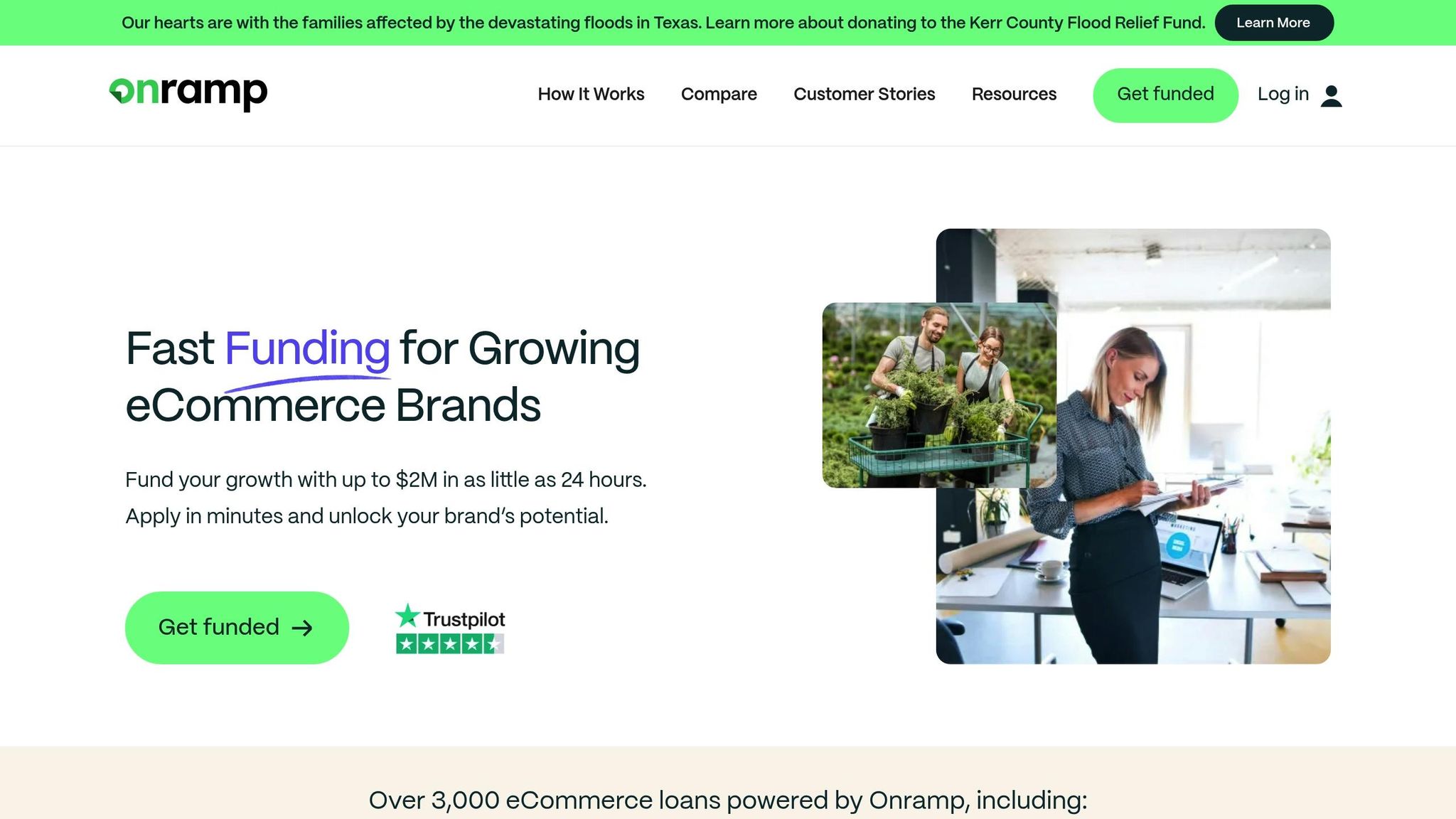
Onramp Funds has become a game-changer for eCommerce businesses, helping sellers tackle cash flow challenges and expand operations through tailored revenue-based financing solutions.
How Onramp Funds Works
Onramp Funds specializes in revenue-based financing by securely connecting to popular eCommerce platforms like Amazon, Shopify, WooCommerce, Squarespace, BigCommerce, Walmart Marketplace, and TikTok Shop using read-only APIs.
The process starts with an online funding calculator that provides a quick estimate. Once your store is linked, Onramp analyzes your sales history and cash flow patterns to create a custom offer. Unlike traditional lenders, they focus on your business's performance and sales trends rather than personal credit scores.
"Most lending services in the market are built for traditional retail and don't really reflect the unique needs of eCommerce. We've built a solution that is uniquely tailored to the eCommerce industry." - Eric Youngstrom, CEO and Founder of Onramp [11]
Repayments are tied directly to your sales. You repay a percentage of your actual sales deposits, meaning payments naturally decrease during slower months and increase during busier periods. Fees range from 2% to 8%, with no hidden charges.
Onramp offers funding amounts of up to $2,000,000, with approvals possible in as little as 24 hours [13]. The minimum requirement of $10,000 in average monthly sales makes it accessible to smaller, growing eCommerce businesses that might struggle with traditional bank loans.
Success Stories from eCommerce Sellers
The impact of Onramp's tailored funding is clear, with customers reporting an average 60% revenue growth and 75% returning for additional funding [12].
Take Anagails Boutique, a family-run business specializing in repurposed luxury fashion. In March 2022, they secured funding from Onramp, resulting in a 90% sales increase and better conversion rates on their Shopify store [14]. This capital allowed them to invest in inventory and marketing without dipping into personal savings.
Another standout example is a business generating $2,000,000 in annual revenue but unable to secure traditional financing due to personal credit requirements. Onramp stepped in, providing working capital based on their sales demand. This funding helped them triple their revenue to $6,000,000.
Then there’s National Parks Depot, founded by Robert Nava. Starting with just $60 in Facebook ads, he generated nearly $1,000 in sales in a single day. Within two months, his revenue skyrocketed to $80,000 [14].
Customer testimonials further highlight the benefits:
"Applied, got our offer, and had cash in our bank account within 24 hours. Their Austin, TX based team was very professional and helped me deploy the cash to effectively grow our business." - Nick James, CEO Rockless Table [10]
"Onramp offered the perfect solution with revenue-based financing to secure the capital we needed to invest in inventory and pay it back at a reasonable time frame once we made sales. The process was quick, easy, and the support was great." - Jeremy, Founder and Owner of Kindfolk Yoga [10]
Why Choose Onramp Funds?
Onramp Funds stands out in the eCommerce financing world, offering a combination of speed, simplicity, and flexibility. The entire process - from application to funding - can take as little as 24 hours, a stark contrast to the lengthy timelines of traditional banks.
Their equity-free financing means you retain full ownership of your business, keeping control and future profits intact.
By integrating directly with your eCommerce platform, Onramp eliminates the paperwork headaches that come with traditional loans. Your sales data flows seamlessly into the system, simplifying both approval and repayment management.
"Onramp has simplified cash flow by automating everything: easy to request, set it and forget it payments - quick and fast!" - Torrie V., Founder and Owner of Torrie's Natural [10]
Onramp’s personalized support adds another layer of value. Their Austin-based team not only provides funding but also offers guidance on how to use it effectively, whether for inventory, marketing, or operational improvements.
Their flexible repayment structure adjusts to your business cycles, ensuring higher repayments during peak seasons and lower payments during slower periods. This flexibility helps protect your cash flow.
With an "Excellent" rating based on 205 reviews, Onramp has earned trust through transparent pricing and reliable service [10][12]. For eCommerce sellers looking to scale without the hurdles of traditional financing, Onramp Funds offers a practical and efficient solution, supporting everything from inventory and shipping to marketing and operations - all while keeping cash flow steady.
Conclusion: Low-Impact Financing for eCommerce Success
As we've explored, syncing financing with revenue cycles can drive smarter growth for eCommerce businesses. Low-impact financing provides a practical way to tackle challenges like rapid expansion and cash flow management, offering a pathway to sustainable success.
Key Takeaways
The world of eCommerce financing has shifted dramatically, moving toward more accessible and adaptable options. Traditional banks often struggle to meet the unique demands of online sellers, while alternative financing has surged, with fintech lending to small and medium-sized enterprises (SMEs) growing by 72.4% annually over the past five years [1].
Revenue-based financing is particularly well-suited for eCommerce businesses. By tying repayments to actual sales, it eases the burden during slower periods. This is critical, considering that cash flow problems account for the failure of 82% of small businesses [15].
Another advantage of low-impact financing is speed. Unlike traditional banks, some providers can deliver funds within 24 hours - a game-changer when you need to restock inventory, act on seasonal opportunities, or scale marketing campaigns quickly.
Next Steps for eCommerce Owners
To make the most of these financing options, eCommerce business owners should take the following steps:
- Assess your financial health: Dive into your monthly sales, profits, costs, and cash reserves to understand what financing and repayment terms make sense for your business [15].
- Shop around: Apply to multiple providers. Many don’t perform hard credit checks during the initial application, so you can compare offers without worrying about your credit score [15].
- Focus on eCommerce-specific solutions: Look for funding options tailored to your needs. Providers like Onramp Funds offer revenue-based financing designed for platforms like Amazon, Shopify, and TikTok Shop, with repayments that adjust to your sales cycles.
Be sure to evaluate the total cost of any loan - interest rates, fees, and other charges - and confirm that repayment terms align with your cash flow. Having your financial documents ready will streamline the process and help you secure the most flexible, sales-driven financing.
As eCommerce continues to grow and change, combining low-impact financing with careful cash flow management can set your business up for long-term success. Whether you're expanding inventory, entering new markets, or ramping up marketing, these tools can help you achieve your goals.
FAQs
How can low-impact financing help eCommerce businesses handle seasonal sales ups and downs?
Low-impact financing offers eCommerce businesses a practical way to handle the ups and downs of seasonal sales. With revenue-based repayment options, payments adjust based on sales performance, meaning businesses aren't overwhelmed during slower months.
This approach also allows sellers to invest in areas like inventory, marketing, or other growth initiatives before peak seasons hit. By doing so, they can boost sales during high-demand periods while keeping their cash flow steady throughout the year.
What are the potential risks of inventory financing, and how can eCommerce businesses reduce them?
Inventory financing comes with its share of risks, such as repayment challenges that might result in lenders seizing inventory. This can disrupt your operations and create significant setbacks. To avoid these pitfalls, eCommerce businesses should prioritize precise demand forecasting to avoid issues like overstocking or running out of stock. Partnering with dependable suppliers and ensuring that inventory is stored safely are also key steps.
On top of that, leveraging tools to track inventory levels in real time allows businesses to adapt quickly to shifts in demand and sales patterns. By staying proactive with inventory management, businesses can better match their financing strategies to their operational needs, helping to minimize potential problems.
How can eCommerce businesses seamlessly use low-impact financing to support their growth?
eCommerce businesses can easily incorporate low-impact financing by embedding financing options directly into their sales platforms, like Shopify, WooCommerce, or BigCommerce. This setup provides access to funding designed to meet their specific needs, helping them manage cash flow, invest in inventory, and expand operations without interrupting their daily processes.
Take Onramp Funds, for instance. They provide flexible, revenue-based financing solutions where repayment adjusts according to your sales performance. By integrating such options into your eCommerce platform, you can simplify your operations, enhance financial management, and concentrate on growing your business effectively.
Related Blog Posts
Onramp Funds
Funding built around your sales
Connect your store and see what you qualify for. Repay as a percentage of sales, with no personal credit check.
Funding in as little as 24 hours.
