


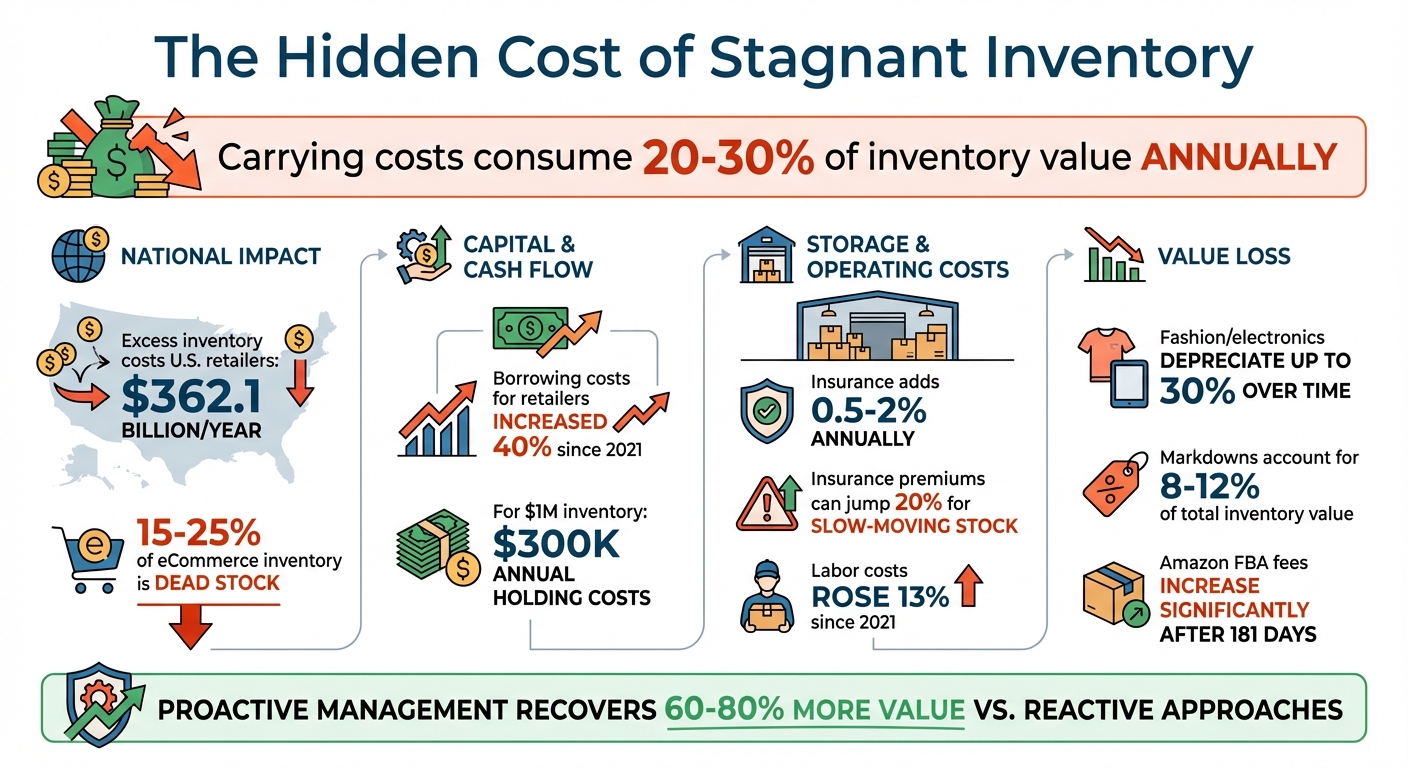
Unsold inventory is a hidden drain on your business. Every product sitting idle on a shelf ties up cash that could be used for growth. On average, carrying costs eat up 20–30% of a product’s value annually, and excess inventory costs U.S. retailers $362.1 billion each year. For eCommerce businesses, 15–25% of inventory is often dead stock, leading to rising storage fees, cash flow issues, and shrinking profit margins.
Key Takeaways:
- Tied-Up Capital: Unsold items limit cash flow, making it harder to invest in marketing or trending products.
- Rising Costs: Storage, insurance, and labor costs increase the longer inventory sits.
- Value Loss: Products lose value over time due to trends, damage, or expiration, often requiring heavy discounts to sell.
- Operational Challenges: Overcrowded warehouses slow fulfillment and increase labor costs.
Solutions to Reduce Costs:
- Demand Forecasting: Use data-driven tools to predict trends and avoid overstocking.
- Turnover Optimization: Implement markdowns, bundling, and inventory aging analysis to sell slow-moving items faster.
- Revenue-Based Financing: Free up capital tied to inventory with flexible, sales-tied repayment options.
By addressing stagnant inventory early, businesses can recover lost cash flow, reduce waste, and improve profitability. Every item sitting unsold is an opportunity to rethink your inventory strategy.
The True Cost of Stagnant Inventory: Key Statistics for eCommerce Businesses
The Hidden Costs of Poor Inventory Management And How to Fix It - Chris Hondl
How Stagnant Inventory Drains Your Finances
Unsold inventory is more than just clutter - it actively drains your business's finances in multiple ways. To protect your profitability, it's essential to understand how this happens. Let’s start with the issue of immobilized capital.
Tied-Up Capital and Limited Cash Flow
When inventory sits unsold, the money you’ve spent on it gets locked up. That’s cash you could have used for marketing, developing new products, or covering operational costs like payroll and utilities - all while earning nothing in return [4][6]. If you borrowed money to purchase that inventory, the problem gets worse: you're paying interest on stock that’s not generating revenue [7]. Since 2021, rising interest rates have pushed borrowing costs for retailers up by 40%, making this an even bigger financial burden [5].
If 15% to 25% of your inventory is made up of slow-moving or dead stock [2], your cash flow takes a serious hit. This makes it harder to pivot quickly, whether that’s jumping on a new opportunity or responding to market changes. But cash flow isn’t the only issue - unsold inventory also drives up your operating expenses.
Rising Storage and Holding Costs
From the moment inventory arrives, the costs of storing it start piling up. These include expenses for warehouse space, utilities, insurance, labor, and even losses from damage or theft. On average, these holding costs can eat up 20% to 30% of your inventory’s value every year [6][7].
Insurance alone adds 0.5% to 2% annually to your inventory costs [2], and if you’re holding large amounts of slow-moving stock, premiums can jump by as much as 20% [1]. Labor costs for warehouse operations have risen 13% since 2021 [5], further squeezing your margins.
"Your warehouse isn't a savings account – those shelves filled with excess stock are actually draining your profits faster than an empty warehouse ever could." - Alexander Jarvis, eCommerce Expert [1]
For a business managing $1 million in inventory, holding costs can total as much as $300,000 annually [8]. That’s money slipping away while your products sit idle, limiting your ability to grow and invest in other areas.
Product Value Loss and Obsolescence
Inventory doesn’t just sit still - it loses value over time. Physical wear and tear, handling damage, and shifting trends all contribute to depreciation [9][6][4]. In industries like fashion and electronics, the value of products can drop by as much as 30% over time [10]. Add in carrying costs that keep piling up, and you may find that your profit margins disappear entirely. To move outdated stock, businesses often resort to markdowns, which typically account for 8% to 12% of total inventory value [6][4][10][2].
A real-world example? In June 2022, Target Corporation faced a major overstock issue caused by pandemic-era supply chain disruptions. CEO Brian Cornell responded by slashing prices and canceling orders, which helped set the stage for profitability recovery in 2023 [5].
If products sit unsold for a year or more, the costs skyrocket. For instance, Amazon FBA sellers face steep storage fee increases after 181 days, with even higher rates beyond a year [6]. These escalating losses make it harder to reinvest in growth, keeping your business stuck in a financial rut.
Operational Problems Created by Excess Inventory
Having too much inventory on hand can create a cascade of operational issues that disrupt efficiency. When warehouses are packed with products that don’t sell quickly, the strain is felt across the board - from how efficiently workers can do their jobs to how quickly orders are fulfilled. Two of the most noticeable impacts are overcrowded storage spaces and rising labor costs.
Warehouse Congestion and Higher Labor Costs
Excess inventory takes up valuable space, often forcing businesses to turn to temporary solutions like storing goods in trucks or off-site facilities. This not only drives up costs but also increases the risk of stock shrinkage [11]. Workers spend extra hours moving, counting, and managing these unsold items, which inflates labor costs and reduces overall productivity [6]. Cluttered aisles make it harder to locate products quickly, slowing down the order fulfillment process [4]. Another issue is that inventory purchasing decisions are frequently disconnected from the realities of managing storage, shrinkage, and obsolescence, further undermining operational efficiency [11].
Forced Discounting and Shrinking Profit Margins
As inefficiencies pile up, businesses often resort to heavy discounting to clear out excess stock. Discounts may start small - 10% or so - but quickly escalate to 25%, 60%, or even 80%, leaving businesses recovering only a fraction of their costs or, worse, selling at a loss [2]. In extreme cases, when the cost of holding inventory outweighs its potential resale value, destroying the stock becomes the most practical option [11].
These operational challenges, from overcrowded warehouses to profit-eroding markdowns, highlight the importance of staying ahead with smart inventory management strategies.
sbb-itb-d7b5115
How to Reduce Inventory Costs
Managing inventory costs effectively can make a big difference in cash flow and profitability. Stagnant inventory ties up valuable resources, so smarter planning, faster turnover, and flexible financing can help free up capital and reduce expenses.
Using Demand Forecasting to Prevent Overstock
Predicting demand accurately is the first step to avoiding overstock issues. By leveraging data-driven forecasting, businesses can significantly reduce supply chain errors and lost sales rates [13]. The trick is to match forecasting techniques to your business needs and product types.
For products with existing sales data, tools like AI-based models can predict future demand with precision [12]. In fact, AI adoption in demand forecasting surged from 23% in 2024 to 48% in 2025, showing how quickly businesses are embracing this technology [15]. For new products with no historical data, qualitative approaches such as expert judgment and market research are invaluable [12][13].
Segmenting inventory is another key step. ABC analysis categorizes products based on value and sales velocity, prioritizing high-value, fast-selling "A" items over slower-moving "C" items [15][16]. XYZ analysis further refines this by grouping products based on demand variability, helping you decide which items need larger safety stock [15][16].
To keep up with shifting demand, use velocity analysis and dynamic reorder points that adjust based on seasonality or trends [6][14]. Before placing new orders, consider transferring surplus stock from slower-selling locations to high-demand areas - a strategy known as transfer planning [6].
"This software has allowed us to stay organized with our inventory, know exactly when orders need to be placed for each of our brands, keep track of out-of-stock or back-ordered products, place purchase orders, and so much more." - Stephanie Parks, CEO, DermWarehouse [12]
Additionally, negotiating flexible Minimum Order Quantities (MOQs) with suppliers can help reduce holding costs by allowing you to order smaller quantities more frequently [6][15]. Cloud-based inventory planning tools, often available at affordable monthly rates, make such strategies accessible even for smaller businesses [12].
Accurate forecasting lays the groundwork for better inventory management and cost reduction.
Improving Inventory Turnover Rates
After improving forecasting, the next step is to speed up how quickly inventory moves through your business. Faster turnover reduces carrying costs, which can be a major expense. On average, eCommerce businesses carry 15-25% dead inventory [2].
Start by conducting an inventory aging analysis, dividing stock into categories like 0-30 days (fresh), 31-60 days (watch list), 61-90 days (slow-moving), and 91+ days (dead stock) [2][3]. This helps pinpoint problems early. For slow-moving items, progressive markdowns can drive sales: begin with a 10-25% discount, increase to 30-50%, and go up to 60-80% for liquidation if necessary [2].
You can also use strategic bundling - pairing slow-moving products with popular ones - to clear inventory while maintaining margins [2][6]. Other options include creating an "Outlet" section on your website or using liquidation brokers and auction platforms to sell excess stock [2][6].
For ongoing operations, adopting Just-In-Time (JIT) principles can help. This approach ensures you receive inventory only when it's needed for fulfillment, minimizing storage costs [17][6]. If you're an Amazon FBA seller, be mindful of long-term storage fees, which increase significantly after 181 and 365 days [6]. Automating replenishment with software that considers lead time and sales trends can also help you avoid over-ordering [17][6].
"It's allowed us to become way better about keeping inventory in stock, made purchasing in time from overseas much easier. It's virtually eliminated shipping errors." - Brett Haney, President, Microfiber Wholesale [12]
By managing dead stock more proactively, businesses can recover 60-80% more value compared to waiting until items become unsellable [2].
If turnover improvements aren't enough, flexible financing can provide the additional cash flow needed to keep operations running smoothly.
Using Revenue-Based Financing to Free Up Cash
Even with excellent forecasting and high turnover, inventory can still tie up capital when you need it most. Traditional financing options - like lines of credit or inventory loans - often come with high interest rates, strict requirements, and long approval times, making them less appealing for eCommerce businesses [18].
Revenue-based financing offers a more flexible solution. With this method, repayment is tied directly to sales, so you only pay back the advance as products sell [18]. This is especially helpful during slower periods, as there are no fixed minimum payments [18].
"You don't have to worry during slow months since the funding option won't bill you. Instead, you'll repay only after selling a product." - Onramp Funds [18]
Onramp Funds specializes in this type of financing for eCommerce businesses, offering funding within 24 hours with no collateral required. By integrating with platforms like Amazon, Shopify, TikTok Shop, and Walmart Marketplace, they provide funding offers based on actual sales data. Fees range from 2-8%, with no hidden costs.
This financing model allows you to reinvest in high-demand "Group A" products (from your ABC analysis) while liquidating slower-moving stock. It helps break the cash flow constraints that often lead to poor operational decisions or excessive discounting.
Comparing Inventory Management Approaches
This section dives into how different inventory management strategies can tackle stagnant inventory while delivering both immediate and long-term benefits. The three main approaches - demand forecasting, turnover optimization, and revenue-based financing - each bring unique advantages depending on your business needs.
Demand forecasting requires more upfront effort because it involves integrating AI tools with your sales data, but the long-term payoff is substantial. Companies using AI-driven forecasting often see a 10–20% reduction in working capital and a 50–60% drop in store shortages [5]. Turnover optimization, which includes techniques like markdowns and bundling, takes less setup and steadily improves cash flow by speeding up cash conversion cycles. Meanwhile, revenue-based financing offers quick liquidity, often providing funds within 24 hours, making it an excellent choice for immediate cash flow needs.
| Strategy | Implementation Time | Cost Impact | Cash Flow | eCommerce Ready |
|---|---|---|---|---|
| Demand Forecasting (AI/ML) | High (Requires data integration) | High (Reduces overstock/stockouts) | 10–20% reduction in tied-up capital [5] | High (Integrates with Shopify, Amazon, Walmart) |
| Turnover Optimization (JIT/Lean) | Moderate (Requires supplier coordination) | Moderate (Lowers storage & labor fees) | High (Accelerates cash conversion cycles) | Moderate (Requires a reliable supply chain) |
| Revenue-Based Financing | Low (Agreement-based) | Variable (Fees vs. recovered margins) | Immediate (Upfront cash for stock) | High (Ideal for scaling SKU-heavy brands) |
A real-world example highlights how combining these strategies can restore profitability. In June 2022, Target Corporation faced a significant inventory surplus caused by pandemic-related supply chain disruptions. The company launched an aggressive right-sizing campaign, which included markdowns, upstream inventory pooling, and canceling vendor orders. CEO Brian Cornell noted that these measures helped set the stage for profitability recovery in 2023 [5]. This case shows how blending forecasting, turnover tactics, and supplier negotiations can solve both short-term cash flow issues and long-term inventory inefficiencies.
To determine the best approach for your business, start by calculating your carrying costs and inventory turnover ratio. High-growth brands, for instance, might benefit from pairing proactive forecasting with flexible, revenue-based financing to avoid future overstock while unlocking capital tied up in current inventory.
"Many businesses underestimate their true inventory holding costs because they fail to account for hidden expenses like opportunity costs and obsolescence risks." - Barry Kukkuk, Co-founder and CTO, Netstock [19]
This quote underscores the importance of understanding all inventory costs - both visible and hidden. Choosing the right strategy can reduce waste while improving your financial flexibility.
Conclusion: Managing Inventory for Better Profitability
Stagnant inventory is more than just a storage issue - it ties up valuable capital and drives up costs through storage fees and markdowns. In fact, carrying costs can eat up 20–30% of your total inventory value annually [19]. Excess inventory is a costly problem, with billions lost each year due to poor inventory management.
The key to solving this challenge is proactive inventory management. Tools like inventory aging reports can pinpoint slow-moving stock - often items sitting in the 61–90 day range - before they turn into dead stock. Combining demand forecasting with strategies to optimize turnover can help prevent overstock situations altogether. Businesses that adopt this approach can recover 60–80% more value compared to relying on reactive measures [2].
When too much capital is tied up in unsold goods, revenue-based financing offers a lifeline. Dead stock levels of 15–25% can significantly hinder growth [2], but financing provides the liquidity needed to invest in high-demand products and seize new opportunities without waiting for stagnant items to clear out.
By integrating advanced forecasting, proactive turnover strategies, and flexible financing options, businesses can maintain healthy cash flow and improve profitability. Every dollar stuck in slow-moving inventory represents a missed chance to grow. When operational tweaks aren't enough, agile financing can inject the capital needed to fuel expansion.
"Many businesses underestimate their true inventory holding costs because they fail to account for hidden expenses like opportunity costs and obsolescence risks." - Barry Kukkuk, Co-founder and CTO, Netstock [19]
Onramp Funds provides revenue-based financing with flexible, sales-tied repayment terms. This solution helps businesses free up capital quickly, clear out warehouse space, and reinvest in products that drive real sales growth.
FAQs
How do I calculate my inventory carrying cost?
To figure out your inventory carrying cost, you’ll need to account for all the yearly expenses tied to storing and maintaining your inventory. These include storage fees, insurance, depreciation, handling costs, taxes, and even opportunity costs (like what else you could have done with the money tied up in inventory).
Here’s how to calculate it step by step:
- Add up all the carrying costs for the year.
- Find your average inventory value using this formula:
(Beginning inventory + Ending inventory) ÷ 2. - Divide the total carrying costs by the average inventory value.
- Multiply the result by 100 to get the carrying cost percentage.
This percentage gives you a clear picture of how much it costs annually to hold your inventory as a proportion of its value.
When does inventory become dead stock?
Dead stock refers to inventory that has been sitting in storage for so long - usually over a year - that it’s unlikely to sell. Holding onto dead stock can drain cash flow, hike up storage expenses, and even cause the items to depreciate in value. This is why staying on top of inventory management is so important.
What’s my inventory turnover ratio and what’s “good”?
Your inventory turnover ratio measures how often your inventory is sold and replenished over a set period, typically a year. For eCommerce businesses, a ratio of 4 to 6 times annually is often seen as ideal. This range strikes a balance by improving cash flow, minimizing storage expenses, and keeping your capital from being tied up in unsold stock. A lower ratio might suggest you’re overstocked, while a higher one could point to frequent stockouts - both scenarios can negatively impact your bottom line.
